


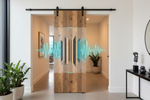
Barn doors are one of the most popular interior design trends in modern homes. They add character, save floor space, and create a strong architectural statement. But before installing one in a bedroom, bathroom, or home office, many homeowners ask:
Are barn doors soundproof?
The honest answer is:
No, barn doors are not soundproof.
They block only a small amount of sound compared to traditional hinged doors.
However, understanding why they perform this way and how much sound they actually reduce, helps you decide whether they are right for your space.
Do Barn Doors Block Sound?
Barn doors provide minimal sound reduction. They are designed for visual separation and style, not acoustic isolation.
On average:
-
Hollow-core barn doors reduce 5–10 decibels (dB)
-
Solid-core barn doors reduce 10–15 decibels (dB)
For comparison:
-
A hollow-core hinged door reduces about 20–25 dB
-
A solid-core hinged door reduces 30–35 dB
-
True soundproofing typically requires 45–50 dB or more
In practical terms, this means:
-
Conversations remain clearly audible.
-
Television and music pass through easily.
-
Bathroom noise is not fully contained.
-
Home office privacy is limited.
Barn doors may slightly muffle sound, but they do not provide true privacy.

Why Barn Doors Are Not Soundproof
The issue is not necessarily the door panel itself. The main problem is the way barn doors are designed and installed.
1. Gaps Around the Door
Barn doors slide along an exposed track mounted above the opening. To move properly, they must leave space around the edges.
Typical installation gaps include:
-
¼–½ inch at the top
-
½ inch or more at the bottom
-
Small gaps along both sides
Sound travels through air. If air can move through a gap, sound can too.
Even small openings significantly reduce sound control.
2. No Door Jamb or Compression Seal
Traditional hinged doors close into a frame. This allows them to:
-
Press tightly against the door stop
-
Use weatherstripping or seals
-
Limit airflow
-
Reduce sound transmission
Barn doors do not close into a frame. They sit in front of the wall.
Because they do not create a perimeter seal, sound easily escapes around the edges.
Even high-end hardware cannot eliminate this structural limitation.

3. Door Thickness and Core Construction
Heavier doors block more sound. This is based on the acoustic principle known as mass law — more mass equals better sound reduction.
However, many barn doors are:
-
Hollow-core
-
Thin solid wood
-
MDF panels with decorative overlays
Lighter doors are easier on track hardware and wall anchors. But lighter panels reduce less sound.
Upgrading to a solid-core barn door improves performance slightly — but the perimeter gaps still prevent strong sound isolation.
The panel may block sound, but the gaps undo much of the benefit.
How Much Sound Do Barn Doors Actually Block?
To put it into perspective:
|
Door Type |
Typical Sound Reduction |
Privacy Level |
|
Hollow-core hinged door |
20–25 dB |
Moderate |
|
Solid-core hinged door |
30–35 dB |
Good |
|
Pocket door |
20–30 dB |
Moderate |
|
Barn door (hollow) |
5–10 dB |
Low |
|
Barn door (solid) |
10–15 dB |
Limited |
A 10 dB reduction may slightly soften voices, but speech remains understandable.
Barn doors are primarily decorative and functional for space-saving — not for blocking noise.
Can You Make a Barn Door More Soundproof?
You cannot make a barn door fully soundproof. However, you can slightly improve performance.
Upgrade to Solid Core
Switching from hollow-core to solid-core:
-
Increases mass
-
Reduces vibration
-
Improves sound reduction slightly
This may increase performance from 5–10 dB to 10–15 dB.
Still, it will not match a sealed hinged door.
Add Perimeter Seals or Brush Strips
You can install:
-
Brush seals
-
Rubber weatherstripping
-
Floor sweeps
-
Adjustable bottom guides
These reduce airflow and slightly improve sound blocking.
However:
-
They can interfere with sliding smoothness
-
They may require maintenance
-
They still do not create a full compression seal
Improve Room Acoustics
If replacing the door is not an option, improving room acoustics can reduce perceived noise.
Consider:
-
Area rugs
-
Upholstered furniture
-
Curtains
-
Acoustic wall panels
-
Fabric décor
This does not stop sound from traveling through the doorway, but it reduces echo and overall noise intensity.

Barn Doors vs Other Door Types for Sound Control
If privacy is important, understanding alternatives helps.
Solid-Core Hinged Doors
The best option for sound control. They seal into a frame and reduce both airborne and impact noise.
Pocket Doors
Better than barn doors, but still not ideal for soundproofing. They have tighter tolerances but do not fully seal.
Double Hinged Doors
Offer excellent sound control when installed with proper seals and astragals.
Barn Doors
Best for aesthetics and space-saving — not for privacy.

When Barn Doors Are a Good Choice
Barn doors work well in spaces where style and layout matter more than sound control.
Good use cases include:
-
Closets
-
Pantries
-
Laundry rooms
-
Decorative room dividers
-
Open-concept spaces
-
Low-noise areas
In these applications, the lack of sound isolation is rarely a problem.
When Barn Doors Are Not Recommended
Avoid barn doors in high-privacy spaces such as:
-
Bedrooms
-
Bathrooms
-
Nurseries
-
Home offices
-
Media rooms
If you expect quiet, barn doors will not meet that expectation.
Are Double Barn Doors Better for Sound?
Double barn doors do not significantly improve sound blocking.
In fact, they often introduce:
-
A center seam
-
Additional gaps
-
More air leakage
Without specialized sealing systems, they still provide limited acoustic privacy.
Final Verdict: Are Barn Doors Soundproof?
No. Barn doors are not soundproof.
They provide minor sound reduction but do not create an airtight barrier.
Choose barn doors if you value:
-
Design
-
Architectural character
-
Space-saving functionality
Choose solid-core hinged doors if you value:
-
Privacy
-
Silence
-
Sleep quality
-
Professional home office performance
Understanding this trade-off helps you make the right decision for your space
Frequently Asked Questions
Do barn doors block sound?
Barn doors block a small amount of sound but are not soundproof. Due to gaps around the perimeter, noise passes through easily.
How many decibels do barn doors reduce?
Hollow barn doors reduce about 5–10 dB. Solid-core barn doors may reduce 10–15 dB.
Are barn doors good for bedrooms?
Barn doors are not ideal for bedrooms if privacy and quiet are important. Sound leakage is noticeable.
Can you soundproof a barn door?
You cannot fully soundproof a barn door. You can improve performance with solid-core panels and seals, but it will never match a sealed hinged door.
What is the best interior door for soundproofing?
A solid-core hinged door with proper seals and tight frame contact offers the best interior sound control.
If you're comparing interior door options and want both design flexibility and performance, explore the full interior door collection at Doors & Beyond to find the right solution for your home.
Are Barn Doors Soundproof? How Much Sound Do Barn Doors Really Block?

Barn doors are one of the most popular interior design trends in modern homes. They add character, save floor space, and create a strong architectural statement. But before installing one in a bedroom, bathroom, or home office, many homeowners ask:
Are barn doors soundproof?
The honest answer is:
No, barn doors are not soundproof.
They block only a small amount of sound compared to traditional hinged doors.
However, understanding why they perform this way and how much sound they actually reduce, helps you decide whether they are right for your space.
Do Barn Doors Block Sound?
Barn doors provide minimal sound reduction. They are designed for visual separation and style, not acoustic isolation.
On average:
-
Hollow-core barn doors reduce 5–10 decibels (dB)
-
Solid-core barn doors reduce 10–15 decibels (dB)
For comparison:
-
A hollow-core hinged door reduces about 20–25 dB
-
A solid-core hinged door reduces 30–35 dB
-
True soundproofing typically requires 45–50 dB or more
In practical terms, this means:
-
Conversations remain clearly audible.
-
Television and music pass through easily.
-
Bathroom noise is not fully contained.
-
Home office privacy is limited.
Barn doors may slightly muffle sound, but they do not provide true privacy.
Why Barn Doors Are Not Soundproof
The issue is not necessarily the door panel itself. The main problem is the way barn doors are designed and installed.
1. Gaps Around the Door
Barn doors slide along an exposed track mounted above the opening. To move properly, they must leave space around the edges.
Typical installation gaps include:
-
¼–½ inch at the top
-
½ inch or more at the bottom
-
Small gaps along both sides
Sound travels through air. If air can move through a gap, sound can too.
Even small openings significantly reduce sound control.
2. No Door Jamb or Compression Seal
Traditional hinged doors close into a frame. This allows them to:
-
Press tightly against the door stop
-
Use weatherstripping or seals
-
Limit airflow
-
Reduce sound transmission
Barn doors do not close into a frame. They sit in front of the wall.
Because they do not create a perimeter seal, sound easily escapes around the edges.
Even high-end hardware cannot eliminate this structural limitation.
3. Door Thickness and Core Construction
Heavier doors block more sound. This is based on the acoustic principle known as mass law — more mass equals better sound reduction.
However, many barn doors are:
-
Hollow-core
-
Thin solid wood
-
MDF panels with decorative overlays
Lighter doors are easier on track hardware and wall anchors. But lighter panels reduce less sound.
Upgrading to a solid-core barn door improves performance slightly — but the perimeter gaps still prevent strong sound isolation.
The panel may block sound, but the gaps undo much of the benefit.
How Much Sound Do Barn Doors Actually Block?
To put it into perspective:
|
Door Type |
Typical Sound Reduction |
Privacy Level |
|
Hollow-core hinged door |
20–25 dB |
Moderate |
|
Solid-core hinged door |
30–35 dB |
Good |
|
Pocket door |
20–30 dB |
Moderate |
|
Barn door (hollow) |
5–10 dB |
Low |
|
Barn door (solid) |
10–15 dB |
Limited |
A 10 dB reduction may slightly soften voices, but speech remains understandable.
Barn doors are primarily decorative and functional for space-saving — not for blocking noise.
Can You Make a Barn Door More Soundproof?
You cannot make a barn door fully soundproof. However, you can slightly improve performance.
Upgrade to Solid Core
Switching from hollow-core to solid-core:
-
Increases mass
-
Reduces vibration
-
Improves sound reduction slightly
This may increase performance from 5–10 dB to 10–15 dB.
Still, it will not match a sealed hinged door.
Add Perimeter Seals or Brush Strips
You can install:
-
Brush seals
-
Rubber weatherstripping
-
Floor sweeps
-
Adjustable bottom guides
These reduce airflow and slightly improve sound blocking.
However:
-
They can interfere with sliding smoothness
-
They may require maintenance
-
They still do not create a full compression seal
Improve Room Acoustics
If replacing the door is not an option, improving room acoustics can reduce perceived noise.
Consider:
-
Area rugs
-
Upholstered furniture
-
Curtains
-
Acoustic wall panels
-
Fabric décor
This does not stop sound from traveling through the doorway, but it reduces echo and overall noise intensity.
Barn Doors vs Other Door Types for Sound Control
If privacy is important, understanding alternatives helps.
Solid-Core Hinged Doors
The best option for sound control. They seal into a frame and reduce both airborne and impact noise.
Pocket Doors
Better than barn doors, but still not ideal for soundproofing. They have tighter tolerances but do not fully seal.
Double Hinged Doors
Offer excellent sound control when installed with proper seals and astragals.
Barn Doors
Best for aesthetics and space-saving — not for privacy.
When Barn Doors Are a Good Choice
Barn doors work well in spaces where style and layout matter more than sound control.
Good use cases include:
-
Closets
-
Pantries
-
Laundry rooms
-
Decorative room dividers
-
Open-concept spaces
-
Low-noise areas
In these applications, the lack of sound isolation is rarely a problem.
When Barn Doors Are Not Recommended
Avoid barn doors in high-privacy spaces such as:
-
Bedrooms
-
Bathrooms
-
Nurseries
-
Home offices
-
Media rooms
If you expect quiet, barn doors will not meet that expectation.
Are Double Barn Doors Better for Sound?
Double barn doors do not significantly improve sound blocking.
In fact, they often introduce:
-
A center seam
-
Additional gaps
-
More air leakage
Without specialized sealing systems, they still provide limited acoustic privacy.
Final Verdict: Are Barn Doors Soundproof?
No. Barn doors are not soundproof.
They provide minor sound reduction but do not create an airtight barrier.
Choose barn doors if you value:
-
Design
-
Architectural character
-
Space-saving functionality
Choose solid-core hinged doors if you value:
-
Privacy
-
Silence
-
Sleep quality
-
Professional home office performance
Understanding this trade-off helps you make the right decision for your space
Frequently Asked Questions
Do barn doors block sound?
Barn doors block a small amount of sound but are not soundproof. Due to gaps around the perimeter, noise passes through easily.
How many decibels do barn doors reduce?
Hollow barn doors reduce about 5–10 dB. Solid-core barn doors may reduce 10–15 dB.
Are barn doors good for bedrooms?
Barn doors are not ideal for bedrooms if privacy and quiet are important. Sound leakage is noticeable.
Can you soundproof a barn door?
You cannot fully soundproof a barn door. You can improve performance with solid-core panels and seals, but it will never match a sealed hinged door.
What is the best interior door for soundproofing?
A solid-core hinged door with proper seals and tight frame contact offers the best interior sound control.
If you're comparing interior door options and want both design flexibility and performance, explore the full interior door collection at Doors & Beyond to find the right solution for your home.


