


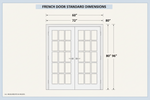
Ordering french doors with the wrong width is one of the most preventable and most expensive mistakes in a renovation project. This guide puts every number you need in one place: standard widths for interior and exterior applications, a complete rough opening chart, and a step-by-step measuring process so you get it right before placing the order.
Standard French Door Widths at a Glance
Before going into the detail of each door type, this table gives you the full picture in a single reference. French doors width varies significantly depending on whether the application is interior or exterior, and whether you are specifying a single panel or a double-door configuration.
|
Door Type |
Standard Widths |
Standard Height |
Common Application |
|
Single interior french door |
18", 24", 28", 30", 32", 36" |
80" |
Bedroom, office, hallway |
|
Double interior french door |
48", 56", 60", 64", 72" |
80", 84" |
Living room, dining room |
|
Single exterior french door |
24", 30", 32", 36" |
80", 84" |
Side entry, mudroom |
|
Double exterior french door |
60", 72", 84", 96" |
80", 84", 96" |
Patio, deck, main entry |
The most important pattern to take from this table: exterior french doors are consistently wider than their interior counterparts. This reflects their primary purpose, which is moving large numbers of people and furniture through a high-traffic opening while maximizing natural light from the outdoors.
Ready to browse by size? Explore the full Interior French Door Collection at Doors and Beyond, available in all standard widths with glazed, frosted, and decorative glass options.
Interior French Door Dimensions
Interior french doors are sized to work within the proportions of standard residential rooms, including standard ceiling heights, narrower hallways, and openings that were originally framed for single doors. Width selection here is driven primarily by the size of the existing or planned opening and the desired visual weight in the space.
Single Interior French Door Width Options
Single interior french doors range from 18 to 36 inches wide per panel. The most common sizes in US residential construction are 30 inches and 36 inches, which fit standard door openings without requiring significant reframing. Key guidance by size:
-
30-inch panel: the most common replacement for an existing hollow-core interior door
-
36-inch panel: standard for master suite entries or home offices where a wider, more prominent opening is desired
-
Sizes below 24 inches: available but rarely used as standalone panels, more common as fixed panels in narrow double-door configurations

Double Interior French Door Width Options
Double interior french doors are specified by their total combined width, with each panel being half that figure. Standard total widths run from 48 to 72 inches. The 60-inch configuration (two 30-inch panels) is one of the most common for living room and dining room dividers. The 72-inch configuration (two 36-inch panels) is used where a grander opening is needed, such as between a great room and a formal dining space.
For a deeper look at double door configurations and how specific sizes perform in different rooms, see the Interior French Door Sizes Complete Guide from Doors and Beyond.
Standard Height for Interior French Doors
The standard height for interior french doors is 80 inches, which aligns with the standard ceiling-to-floor door opening in most US homes built after 1950. An 84-inch option is used in newer construction with 9-foot ceilings, and 96-inch doors are available for high-ceiling applications. Height is typically less variable than width because the floor-to-ceiling dimension is fixed by the framing, while width can be adjusted by modifying the rough opening.

Thickness: The Often-Overlooked Dimension
Interior french door thickness is either 1 3/4 inches or 1 9/16 inches depending on the door construction and manufacturer. Most standard prehung interior french doors use 1 3/4-inch thickness, which is compatible with the majority of standard interior jamb widths. Thickness matters when selecting hardware because hinges, lock sets, and astragal components are all specified for a particular door thickness, and mismatching causes fitment problems during installation.
French Door Rough Opening Size Chart
The rough opening is not the size of the door. It is the framed space the door unit goes into before the jamb and trim are installed. Confusing rough opening size with door size is the most common ordering mistake for both interior and exterior french doors. The rule across both applications is consistent: add 2 inches to the door unit width and 2.5 inches to the door unit height to calculate the required rough opening.
How to Calculate Rough Opening Width
The formula applies the same way for single and double configurations:
-
Single french door: add 2 inches to the door width
-
Double french door: use the combined total width of both panels, then add 2 inches
-
Height (both types): add 2.5 inches to account for 1.5 inches of shimming at the top and 1 inch of clearance at the bottom threshold
Rough Opening Formula and Reference Chart
|
Door Size (W x H) |
Door Type |
Rough Opening Width |
Rough Opening Height |
|
30" x 80" |
Single interior |
32" |
82.5" |
|
36" x 80" |
Single interior |
38" |
82.5" |
|
60" x 80" |
Double interior |
62" |
82.5" |
|
72" x 80" |
Double interior |
74" |
82.5" |
|
72" x 84" |
Double exterior |
74" |
86.5" |
|
84" x 80" |
Double exterior |
86" |
82.5" |
|
96" x 80" |
Double exterior |
98" |
82.5" |
|
96" x 96" |
Double exterior |
98" |
98.5" |
The rough opening dimensions in this table are the minimum required for standard prehung french door units. Always verify with your specific manufacturer's installation instructions, as frame thickness varies and some units require slightly more shimming clearance than the standard formula provides.
How to Measure Your Opening for French Doors
Measuring accurately before ordering is what separates a straightforward installation from a costly return and reorder. The process takes less than 15 minutes and requires only a tape measure, a pencil, and paper.
Step 1 – Measure Width at Three Points
Measure the width of the opening at the top, middle, and bottom. Walls and frames are rarely perfectly square, which means these three measurements will often differ slightly. Record all three and use the smallest measurement as your working width. This ensures the door unit will fit through the narrowest point of the opening without binding.
Step 2 – Measure Height at Two Points
Measure the height from the finished floor to the top of the rough opening on both the left and right sides. Use the larger of the two measurements as your working height. This ensures the door unit does not fall short of the opening on the taller side.
Step 3 – Measure Frame Depth
Measure the depth of the wall from the interior face to the exterior face. Most US residential walls fall into one of two standard depths:
-
4.5 inches: 2x4 framing plus drywall on both sides
-
6.5 inches: 2x6 framing plus drywall on both sides
This measurement determines whether a standard jamb width will be flush with your wall surface, or whether you will need an extended jamb or casing build-out to cover the gap.

Which Measurement to Use When Numbers Differ
Width: always use the smallest measurement. Height: always use the largest measurement. Frame depth: match this exactly to your jamb width specification. If any measurement is more than 1/4 inch different from the others at the same point, inspect the framing for damage or out-of-plumb conditions before ordering.
For a full walkthrough of the installation process once you have your measurements confirmed, see the How to Install Interior French Doors guide from Doors and Beyond.
Choosing the Right Width by Room and Application
Standard sizes give you a range to work within. The right width within that range depends on how the space is used, what furniture it contains, and what visual proportion works for the room. These guidelines apply consistently across US residential construction.
Living Room and Great Room
Double french doors in the 60 to 72-inch total width range are the standard specification for living rooms and great rooms used as interior room dividers or patio access points. A 72-inch double door (two 36-inch panels) creates a proportional opening in most rooms with 8 to 9-foot ceilings. For rooms wider than 18 feet or with higher ceilings, an 84-inch double door maintains better visual proportion.
Bedroom and Master Suite
A single 36-inch french door is appropriate for most bedrooms and provides the 32-inch clear opening width required for ADA accessibility compliance. For master suites, a 60-inch double door configuration (two 30-inch panels) creates a more architecturally significant entry without requiring the larger rough opening that a 72-inch double door demands. Each panel needs clear floor space equal to its width for full opening, so account for 30 or 36 inches of swing clearance on the appropriate side.

ADA Compliance: Minimum Width Requirements
The Americans with Disabilities Act requires a minimum 32-inch clear opening width for wheelchair accessibility in applicable applications. This means the door panel itself must be at least 34 inches wide to provide 32 inches of clear passage after accounting for the door stop and hinge. In residential new construction that falls under ADA or visitability requirements, verify clear opening width rather than nominal door width before finalizing your size selection.
Standard vs Custom French Door Sizes
Standard sizes cover the overwhelming majority of residential openings. Custom sizing exists for the situations where they do not, and understanding when you actually need custom versus when a standard door with modified framing achieves the same result can save significant cost and lead time.
When Standard Sizes Are the Right Choice
Standard french door sizes are the right choice whenever the rough opening can be adjusted to fit a standard unit. Adding a strip of lumber to a jack stud to narrow an oversized opening, or trimming a jack stud to widen a slightly tight opening, is far less expensive than ordering a custom door. Standard sizes also ship faster, carry warranty coverage more consistently, and have hardware that is immediately available for replacement.
When to Consider Custom Dimensions
Custom sizing is necessary in the following situations:
-
Load-bearing walls where modifying the header would require structural engineering
-
Historic homes where preserving original masonry openings is required
-
High-end architectural projects where a specific width is designed into the building plans from the start
-
Very large exterior openings exceeding 96 inches where standard product lines do not reach
What Custom Sizing Typically Costs and Takes
Custom french doors typically cost 20 to 50 percent more than equivalent standard sizes and require 4 to 8 weeks of lead time versus 1 to 2 weeks for standard in-stock units. Before committing to custom sizing, confirm with your door supplier whether a standard size with modified jamb extensions or trim build-outs can achieve the same result. In most cases it can, at substantially lower cost and faster delivery.
Conclusion
Standard french doors width runs from 18 to 36 inches for single panels and 48 to 96 inches for double configurations. Exterior doors trend wider than interior. Always add 2 inches to door width and 2.5 inches to door height to get your rough opening dimensions. Measure at three points, use the smallest width and the largest height, and verify frame depth before ordering. Standard sizes solve most situations without the cost or lead time of custom.
French Doors Width and Dimensions: Complete Size Guide for Interior and Exterior

Ordering french doors with the wrong width is one of the most preventable and most expensive mistakes in a renovation project. This guide puts every number you need in one place: standard widths for interior and exterior applications, a complete rough opening chart, and a step-by-step measuring process so you get it right before placing the order.
Standard French Door Widths at a Glance
Before going into the detail of each door type, this table gives you the full picture in a single reference. French doors width varies significantly depending on whether the application is interior or exterior, and whether you are specifying a single panel or a double-door configuration.
|
Door Type |
Standard Widths |
Standard Height |
Common Application |
|
Single interior french door |
18", 24", 28", 30", 32", 36" |
80" |
Bedroom, office, hallway |
|
Double interior french door |
48", 56", 60", 64", 72" |
80", 84" |
Living room, dining room |
|
Single exterior french door |
24", 30", 32", 36" |
80", 84" |
Side entry, mudroom |
|
Double exterior french door |
60", 72", 84", 96" |
80", 84", 96" |
Patio, deck, main entry |
The most important pattern to take from this table: exterior french doors are consistently wider than their interior counterparts. This reflects their primary purpose, which is moving large numbers of people and furniture through a high-traffic opening while maximizing natural light from the outdoors.
Ready to browse by size? Explore the full Interior French Door Collection at Doors and Beyond, available in all standard widths with glazed, frosted, and decorative glass options.
Interior French Door Dimensions
Interior french doors are sized to work within the proportions of standard residential rooms, including standard ceiling heights, narrower hallways, and openings that were originally framed for single doors. Width selection here is driven primarily by the size of the existing or planned opening and the desired visual weight in the space.
Single Interior French Door Width Options
Single interior french doors range from 18 to 36 inches wide per panel. The most common sizes in US residential construction are 30 inches and 36 inches, which fit standard door openings without requiring significant reframing. Key guidance by size:
-
30-inch panel: the most common replacement for an existing hollow-core interior door
-
36-inch panel: standard for master suite entries or home offices where a wider, more prominent opening is desired
-
Sizes below 24 inches: available but rarely used as standalone panels, more common as fixed panels in narrow double-door configurations
Double Interior French Door Width Options
Double interior french doors are specified by their total combined width, with each panel being half that figure. Standard total widths run from 48 to 72 inches. The 60-inch configuration (two 30-inch panels) is one of the most common for living room and dining room dividers. The 72-inch configuration (two 36-inch panels) is used where a grander opening is needed, such as between a great room and a formal dining space.
For a deeper look at double door configurations and how specific sizes perform in different rooms, see the Interior French Door Sizes Complete Guide from Doors and Beyond.
Standard Height for Interior French Doors
The standard height for interior french doors is 80 inches, which aligns with the standard ceiling-to-floor door opening in most US homes built after 1950. An 84-inch option is used in newer construction with 9-foot ceilings, and 96-inch doors are available for high-ceiling applications. Height is typically less variable than width because the floor-to-ceiling dimension is fixed by the framing, while width can be adjusted by modifying the rough opening.
Thickness: The Often-Overlooked Dimension
Interior french door thickness is either 1 3/4 inches or 1 9/16 inches depending on the door construction and manufacturer. Most standard prehung interior french doors use 1 3/4-inch thickness, which is compatible with the majority of standard interior jamb widths. Thickness matters when selecting hardware because hinges, lock sets, and astragal components are all specified for a particular door thickness, and mismatching causes fitment problems during installation.
French Door Rough Opening Size Chart
The rough opening is not the size of the door. It is the framed space the door unit goes into before the jamb and trim are installed. Confusing rough opening size with door size is the most common ordering mistake for both interior and exterior french doors. The rule across both applications is consistent: add 2 inches to the door unit width and 2.5 inches to the door unit height to calculate the required rough opening.
How to Calculate Rough Opening Width
The formula applies the same way for single and double configurations:
-
Single french door: add 2 inches to the door width
-
Double french door: use the combined total width of both panels, then add 2 inches
-
Height (both types): add 2.5 inches to account for 1.5 inches of shimming at the top and 1 inch of clearance at the bottom threshold
Rough Opening Formula and Reference Chart
|
Door Size (W x H) |
Door Type |
Rough Opening Width |
Rough Opening Height |
|
30" x 80" |
Single interior |
32" |
82.5" |
|
36" x 80" |
Single interior |
38" |
82.5" |
|
60" x 80" |
Double interior |
62" |
82.5" |
|
72" x 80" |
Double interior |
74" |
82.5" |
|
72" x 84" |
Double exterior |
74" |
86.5" |
|
84" x 80" |
Double exterior |
86" |
82.5" |
|
96" x 80" |
Double exterior |
98" |
82.5" |
|
96" x 96" |
Double exterior |
98" |
98.5" |
The rough opening dimensions in this table are the minimum required for standard prehung french door units. Always verify with your specific manufacturer's installation instructions, as frame thickness varies and some units require slightly more shimming clearance than the standard formula provides.
How to Measure Your Opening for French Doors
Measuring accurately before ordering is what separates a straightforward installation from a costly return and reorder. The process takes less than 15 minutes and requires only a tape measure, a pencil, and paper.
Step 1 – Measure Width at Three Points
Measure the width of the opening at the top, middle, and bottom. Walls and frames are rarely perfectly square, which means these three measurements will often differ slightly. Record all three and use the smallest measurement as your working width. This ensures the door unit will fit through the narrowest point of the opening without binding.
Step 2 – Measure Height at Two Points
Measure the height from the finished floor to the top of the rough opening on both the left and right sides. Use the larger of the two measurements as your working height. This ensures the door unit does not fall short of the opening on the taller side.
Step 3 – Measure Frame Depth
Measure the depth of the wall from the interior face to the exterior face. Most US residential walls fall into one of two standard depths:
-
4.5 inches: 2x4 framing plus drywall on both sides
-
6.5 inches: 2x6 framing plus drywall on both sides
This measurement determines whether a standard jamb width will be flush with your wall surface, or whether you will need an extended jamb or casing build-out to cover the gap.
Which Measurement to Use When Numbers Differ
Width: always use the smallest measurement. Height: always use the largest measurement. Frame depth: match this exactly to your jamb width specification. If any measurement is more than 1/4 inch different from the others at the same point, inspect the framing for damage or out-of-plumb conditions before ordering.
For a full walkthrough of the installation process once you have your measurements confirmed, see the How to Install Interior French Doors guide from Doors and Beyond.
Choosing the Right Width by Room and Application
Standard sizes give you a range to work within. The right width within that range depends on how the space is used, what furniture it contains, and what visual proportion works for the room. These guidelines apply consistently across US residential construction.
Living Room and Great Room
Double french doors in the 60 to 72-inch total width range are the standard specification for living rooms and great rooms used as interior room dividers or patio access points. A 72-inch double door (two 36-inch panels) creates a proportional opening in most rooms with 8 to 9-foot ceilings. For rooms wider than 18 feet or with higher ceilings, an 84-inch double door maintains better visual proportion.
Bedroom and Master Suite
A single 36-inch french door is appropriate for most bedrooms and provides the 32-inch clear opening width required for ADA accessibility compliance. For master suites, a 60-inch double door configuration (two 30-inch panels) creates a more architecturally significant entry without requiring the larger rough opening that a 72-inch double door demands. Each panel needs clear floor space equal to its width for full opening, so account for 30 or 36 inches of swing clearance on the appropriate side.
ADA Compliance: Minimum Width Requirements
The Americans with Disabilities Act requires a minimum 32-inch clear opening width for wheelchair accessibility in applicable applications. This means the door panel itself must be at least 34 inches wide to provide 32 inches of clear passage after accounting for the door stop and hinge. In residential new construction that falls under ADA or visitability requirements, verify clear opening width rather than nominal door width before finalizing your size selection.
Standard vs Custom French Door Sizes
Standard sizes cover the overwhelming majority of residential openings. Custom sizing exists for the situations where they do not, and understanding when you actually need custom versus when a standard door with modified framing achieves the same result can save significant cost and lead time.
When Standard Sizes Are the Right Choice
Standard french door sizes are the right choice whenever the rough opening can be adjusted to fit a standard unit. Adding a strip of lumber to a jack stud to narrow an oversized opening, or trimming a jack stud to widen a slightly tight opening, is far less expensive than ordering a custom door. Standard sizes also ship faster, carry warranty coverage more consistently, and have hardware that is immediately available for replacement.
When to Consider Custom Dimensions
Custom sizing is necessary in the following situations:
-
Load-bearing walls where modifying the header would require structural engineering
-
Historic homes where preserving original masonry openings is required
-
High-end architectural projects where a specific width is designed into the building plans from the start
-
Very large exterior openings exceeding 96 inches where standard product lines do not reach
What Custom Sizing Typically Costs and Takes
Custom french doors typically cost 20 to 50 percent more than equivalent standard sizes and require 4 to 8 weeks of lead time versus 1 to 2 weeks for standard in-stock units. Before committing to custom sizing, confirm with your door supplier whether a standard size with modified jamb extensions or trim build-outs can achieve the same result. In most cases it can, at substantially lower cost and faster delivery.
Conclusion
Standard french doors width runs from 18 to 36 inches for single panels and 48 to 96 inches for double configurations. Exterior doors trend wider than interior. Always add 2 inches to door width and 2.5 inches to door height to get your rough opening dimensions. Measure at three points, use the smallest width and the largest height, and verify frame depth before ordering. Standard sizes solve most situations without the cost or lead time of custom.


