


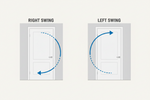
When ordering a new door, getting the swing direction wrong is one of the most expensive mistakes a homeowner can make. The difference between a right and left swing door comes down to one thing: which side the hinges are on. This guide breaks it down clearly, with a comparison table, four handing types, and room-by-room guidance, so you order with confidence.
What Do "Right Swing" and "Left Swing" Actually Mean?
Most people have opened thousands of doors without ever thinking about swing direction, until it's time to buy one. That's when the confusion starts. The terms "right swing" and "left swing" sound simple, but they trip up even experienced DIYers because the answer changes depending on which side of the door you're standing on.
The Simple Definition of Door Handing
Door handing, also called door swing direction, describes which side the hinges are on and which way the door opens. It's a spec used by manufacturers and hardware suppliers to ensure every component of a door unit fits together correctly. Get it right, and installation is seamless. Get it wrong, and you're looking at return shipping costs, project delays, and potentially a door that can't be installed at all.
Right Swing Door Explained
A right swing door has its hinges mounted on the right side of the door frame. When you open it, the door swings toward the right. The handle or knob sits on the left side. This is also called a right-hand door (RH) in most US industry terminology.

Left Swing Door Explained
A left swing door has its hinges on the left side of the frame, and the door swings open to the left. The handle sits on the right side. In industry terms, this is a left-hand door (LH).
Why the Same Door Can Look Different from Each Side
Here's the root cause of most confusion: a door looks different depending on which side you're standing on. Stand on one side and the hinges are on the left. Walk to the other side and now the hinges appear to be on the right. This is why every method for determining door swing requires you to stand in one specific, consistent position before making a call.
>>> See more: What is a Prehung Interior Door? Difference Between Prehung and Slab door
How to Determine If Your Door Is Right or Left Swing
Knowing the definition is one thing. Being able to walk up to a door and correctly identify its swing direction, before you order, is what actually saves you money. There are two reliable methods, and both take less than 30 seconds.
Method 1 – The Outside/Key Side Method (Easiest)
This is the most straightforward approach and works for both exterior and interior doors.
Step 1: Identify the outside, or "key side," of the door. For a front entry door, this is the exterior of your home, the side you approach from the street. For an interior door, it's the side outside the room (standing in the hallway looking toward the bedroom, for example).
Step 2: Stand on that outside facing the closed door.
Step 3: Look at which side the hinges are on. Hinges on the left = left swing door. Hinges on the right = right swing door.
That's it. No tools, no guesswork.

Method 2 – Back-to-Hinge Method (Most Reliable)
This method eliminates any uncertainty about which side is the "outside" and is particularly useful for interior doors where both sides look similar.
Step 1: Open the door fully.
Step 2: Stand with your back flat against the hinge jamb, the side of the frame where the hinges are mounted.
Step 3: Reach out to the side. Whichever hand naturally reaches toward the door knob is the hand that names the door. Right hand reaches the knob = right swing door. Left hand reaches the knob = left swing door.
Quick Visual Check: Hinge Side = Swing Side
As a fast mental shortcut: the door always swings toward the same side as the hinges. Hinges on the right, door swings right. Hinges on the left, door swings left. This rule holds true across virtually all standard swing doors.
Right Swing vs. Left Swing – The Key Differences at a Glance
Once you've identified your door's swing direction using either method above, the table below gives you a clear side-by-side comparison of what each configuration means for hardware placement, installation, and ordering.
|
Feature |
Right Swing Door |
Left Swing Door |
|
Hinge position |
Right side of frame |
Left side of frame |
|
Handle/knob position |
Left side |
Right side |
|
Opens toward |
Right |
Left |
|
Industry code |
RH (Right-Hand) |
LH (Left-Hand) |
|
Hardware required |
Right-hand hardware set |
Left-hand hardware set |
|
Most common use |
Varies by room layout |
Varies by room layout |
The most important takeaway from this table: hinge side and handle side are always opposite. If you order hardware for a right swing door, that hardware is specifically designed for hinges on the right and a knob on the left. Mixing these up, even accidentally, means your lockset won't fit correctly.
If you're unsure which swing doors to choose, check out the Single Swing Doors and Double Swing Doors Collection at Doors and Beyond.
Inswing vs. Outswing – The Other Variable You Need to Know
Right vs. left swing tells you half the story. The other half is whether the door swings into the room or away from it. When ordering a door, you need both pieces of information to get the correct unit and the correct hardware.
What Is an Inswing Door?
An inswing door opens toward you as you enter a space. Standing on the outside of the room and pulling the door toward you: that's an inswing. This is the most common configuration for interior doors throughout US homes, as it keeps the door from blocking hallways or exterior pathways.
What Is an Outswing Door?
An outswing door opens away from you as you enter. You push it open, and it swings out toward the exterior or hallway. Many exterior doors in regions with severe weather are built as outswing units because the design makes them more resistant to wind pressure and forced entry.

The 4 Door Handing Combinations Explained
Combining left/right with inswing/outswing gives you four possible configurations. Every door you order falls into one of these four categories:
|
Code |
Full Name |
Hinge Side |
Swing Direction |
Typical Application |
|
LHIS |
Left Hand Inswing |
Left |
Inward to left |
Interior bedroom, closet |
|
LHOS |
Left Hand Outswing |
Left |
Outward to left |
Some exterior side doors |
|
RHIS |
Right Hand Inswing |
Right |
Inward to right |
Common exterior entry |
|
RHOS |
Right Hand Outswing |
Right |
Outward to right |
Garage entry, ADA-compliant doors |
When you contact a door supplier or use an online configurator, these four codes are what you'll be selecting from. Knowing your code before you shop eliminates back-and-forth with sales staff and dramatically reduces the risk of receiving the wrong door.
Choosing the Right Door Swing for Each Room
Swing direction is not just a technical specification. It shapes how a room feels and functions every single day. A door that swings into a narrow hallway creates a hazard. One that blocks a light switch is an everyday annoyance. Thinking through swing direction by room type leads to better decisions that you won't regret six months after installation.
Front Entry Doors – What's Most Common in the US?
The majority of US exterior entry doors are right-hand inswing (RHIS). This configuration positions the door to swing into the home while keeping the hinges on the right, which aligns with the standard approach path for most American home designs. That said, your specific layout, where the nearest wall is, the position of the staircase, and foot traffic patterns, should always take priority over convention.
Outswing exterior doors are less common but worth considering if interior space is limited near the entryway, or if you're in a high-wind area where an outswing door provides better weather resistance.
Bedroom Doors – Privacy and Traffic Flow First
For bedroom doors, the swing should open away from the bed and avoid blocking the closet, dresser, or any furniture placed near the entrance. The goal is a door that fully opens to 90 degrees without hitting anything. Stand in the doorway and mentally trace the arc of the swing. If it clears all obstacles, you have the right configuration.
Most bedroom doors are inswing, keeping the arc contained within the room rather than projecting into a shared hallway.
>>> See more: 7 Stunning French Door Ideas for Your Bedroom Makeover

Bathroom Doors – Building Code Matters Here
Bathroom doors carry specific considerations beyond preference. In many US jurisdictions, bathroom doors are required to swing outward into the hallway rather than inward, to allow emergency access if someone falls against the door from inside. Always check local building codes before specifying a bathroom door swing during a remodel or new build.
In smaller bathrooms, an outswing door also prevents the door from colliding with the toilet or vanity when opened, which is both a practical and safety benefit.
Garage Entry Doors – Safety and Egress Rules
The door connecting your home's interior to an attached garage follows fire safety and egress requirements that override personal preference. In most US building codes, this door must swing into the garage, functioning as an outswing door from the home's perspective, so that occupants can exit quickly in the event of fire or explosion inside the garage.
Confirm your local fire code before ordering a garage entry door, as the required swing direction directly determines whether you need an inswing or outswing unit.
Conclusion
The difference between a right and left swing door is straightforward once you know where to stand: face the outside of the door, and the hinge side tells you everything. Combine that with inswing or outswing, and you have the full handing code, LHIS, LHOS, RHIS, or RHOS, needed to order any door correctly. Use the room-by-room guidance above to make sure your swing direction works with your layout, not against it.
Ready to find your next door? Shop the full collection at Doors and Beyond
Right vs. Left Swing Door: What's the Difference and How to Tell Every Time

When ordering a new door, getting the swing direction wrong is one of the most expensive mistakes a homeowner can make. The difference between a right and left swing door comes down to one thing: which side the hinges are on. This guide breaks it down clearly, with a comparison table, four handing types, and room-by-room guidance, so you order with confidence.
What Do "Right Swing" and "Left Swing" Actually Mean?
Most people have opened thousands of doors without ever thinking about swing direction, until it's time to buy one. That's when the confusion starts. The terms "right swing" and "left swing" sound simple, but they trip up even experienced DIYers because the answer changes depending on which side of the door you're standing on.
The Simple Definition of Door Handing
Door handing, also called door swing direction, describes which side the hinges are on and which way the door opens. It's a spec used by manufacturers and hardware suppliers to ensure every component of a door unit fits together correctly. Get it right, and installation is seamless. Get it wrong, and you're looking at return shipping costs, project delays, and potentially a door that can't be installed at all.
Right Swing Door Explained
A right swing door has its hinges mounted on the right side of the door frame. When you open it, the door swings toward the right. The handle or knob sits on the left side. This is also called a right-hand door (RH) in most US industry terminology.
Left Swing Door Explained
A left swing door has its hinges on the left side of the frame, and the door swings open to the left. The handle sits on the right side. In industry terms, this is a left-hand door (LH).
Why the Same Door Can Look Different from Each Side
Here's the root cause of most confusion: a door looks different depending on which side you're standing on. Stand on one side and the hinges are on the left. Walk to the other side and now the hinges appear to be on the right. This is why every method for determining door swing requires you to stand in one specific, consistent position before making a call.
>>> See more: What is a Prehung Interior Door? Difference Between Prehung and Slab door
How to Determine If Your Door Is Right or Left Swing
Knowing the definition is one thing. Being able to walk up to a door and correctly identify its swing direction, before you order, is what actually saves you money. There are two reliable methods, and both take less than 30 seconds.
Method 1 – The Outside/Key Side Method (Easiest)
This is the most straightforward approach and works for both exterior and interior doors.
Step 1: Identify the outside, or "key side," of the door. For a front entry door, this is the exterior of your home, the side you approach from the street. For an interior door, it's the side outside the room (standing in the hallway looking toward the bedroom, for example).
Step 2: Stand on that outside facing the closed door.
Step 3: Look at which side the hinges are on. Hinges on the left = left swing door. Hinges on the right = right swing door.
That's it. No tools, no guesswork.
Method 2 – Back-to-Hinge Method (Most Reliable)
This method eliminates any uncertainty about which side is the "outside" and is particularly useful for interior doors where both sides look similar.
Step 1: Open the door fully.
Step 2: Stand with your back flat against the hinge jamb, the side of the frame where the hinges are mounted.
Step 3: Reach out to the side. Whichever hand naturally reaches toward the door knob is the hand that names the door. Right hand reaches the knob = right swing door. Left hand reaches the knob = left swing door.
Quick Visual Check: Hinge Side = Swing Side
As a fast mental shortcut: the door always swings toward the same side as the hinges. Hinges on the right, door swings right. Hinges on the left, door swings left. This rule holds true across virtually all standard swing doors.
Right Swing vs. Left Swing – The Key Differences at a Glance
Once you've identified your door's swing direction using either method above, the table below gives you a clear side-by-side comparison of what each configuration means for hardware placement, installation, and ordering.
|
Feature |
Right Swing Door |
Left Swing Door |
|
Hinge position |
Right side of frame |
Left side of frame |
|
Handle/knob position |
Left side |
Right side |
|
Opens toward |
Right |
Left |
|
Industry code |
RH (Right-Hand) |
LH (Left-Hand) |
|
Hardware required |
Right-hand hardware set |
Left-hand hardware set |
|
Most common use |
Varies by room layout |
Varies by room layout |
The most important takeaway from this table: hinge side and handle side are always opposite. If you order hardware for a right swing door, that hardware is specifically designed for hinges on the right and a knob on the left. Mixing these up, even accidentally, means your lockset won't fit correctly.
If you're unsure which swing doors to choose, check out the Single Swing Doors and Double Swing Doors Collection at Doors and Beyond.
Inswing vs. Outswing – The Other Variable You Need to Know
Right vs. left swing tells you half the story. The other half is whether the door swings into the room or away from it. When ordering a door, you need both pieces of information to get the correct unit and the correct hardware.
What Is an Inswing Door?
An inswing door opens toward you as you enter a space. Standing on the outside of the room and pulling the door toward you: that's an inswing. This is the most common configuration for interior doors throughout US homes, as it keeps the door from blocking hallways or exterior pathways.
What Is an Outswing Door?
An outswing door opens away from you as you enter. You push it open, and it swings out toward the exterior or hallway. Many exterior doors in regions with severe weather are built as outswing units because the design makes them more resistant to wind pressure and forced entry.
The 4 Door Handing Combinations Explained
Combining left/right with inswing/outswing gives you four possible configurations. Every door you order falls into one of these four categories:
|
Code |
Full Name |
Hinge Side |
Swing Direction |
Typical Application |
|
LHIS |
Left Hand Inswing |
Left |
Inward to left |
Interior bedroom, closet |
|
LHOS |
Left Hand Outswing |
Left |
Outward to left |
Some exterior side doors |
|
RHIS |
Right Hand Inswing |
Right |
Inward to right |
Common exterior entry |
|
RHOS |
Right Hand Outswing |
Right |
Outward to right |
Garage entry, ADA-compliant doors |
When you contact a door supplier or use an online configurator, these four codes are what you'll be selecting from. Knowing your code before you shop eliminates back-and-forth with sales staff and dramatically reduces the risk of receiving the wrong door.
Choosing the Right Door Swing for Each Room
Swing direction is not just a technical specification. It shapes how a room feels and functions every single day. A door that swings into a narrow hallway creates a hazard. One that blocks a light switch is an everyday annoyance. Thinking through swing direction by room type leads to better decisions that you won't regret six months after installation.
Front Entry Doors – What's Most Common in the US?
The majority of US exterior entry doors are right-hand inswing (RHIS). This configuration positions the door to swing into the home while keeping the hinges on the right, which aligns with the standard approach path for most American home designs. That said, your specific layout, where the nearest wall is, the position of the staircase, and foot traffic patterns, should always take priority over convention.
Outswing exterior doors are less common but worth considering if interior space is limited near the entryway, or if you're in a high-wind area where an outswing door provides better weather resistance.
Bedroom Doors – Privacy and Traffic Flow First
For bedroom doors, the swing should open away from the bed and avoid blocking the closet, dresser, or any furniture placed near the entrance. The goal is a door that fully opens to 90 degrees without hitting anything. Stand in the doorway and mentally trace the arc of the swing. If it clears all obstacles, you have the right configuration.
Most bedroom doors are inswing, keeping the arc contained within the room rather than projecting into a shared hallway.
>>> See more: 7 Stunning French Door Ideas for Your Bedroom Makeover
Bathroom Doors – Building Code Matters Here
Bathroom doors carry specific considerations beyond preference. In many US jurisdictions, bathroom doors are required to swing outward into the hallway rather than inward, to allow emergency access if someone falls against the door from inside. Always check local building codes before specifying a bathroom door swing during a remodel or new build.
In smaller bathrooms, an outswing door also prevents the door from colliding with the toilet or vanity when opened, which is both a practical and safety benefit.
Garage Entry Doors – Safety and Egress Rules
The door connecting your home's interior to an attached garage follows fire safety and egress requirements that override personal preference. In most US building codes, this door must swing into the garage, functioning as an outswing door from the home's perspective, so that occupants can exit quickly in the event of fire or explosion inside the garage.
Confirm your local fire code before ordering a garage entry door, as the required swing direction directly determines whether you need an inswing or outswing unit.
Conclusion
The difference between a right and left swing door is straightforward once you know where to stand: face the outside of the door, and the hinge side tells you everything. Combine that with inswing or outswing, and you have the full handing code, LHIS, LHOS, RHIS, or RHOS, needed to order any door correctly. Use the room-by-room guidance above to make sure your swing direction works with your layout, not against it.
Ready to find your next door? Shop the full collection at Doors and Beyond
Recent Post

How to Cover Sliding Glass Doors: Best Window Treatment Ideas for Every Style and Budget
Read More
Standard Sliding Glass Door Sizes: Width, Height, Rough Opening, and How to Choose
Read More
