


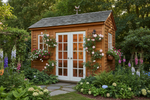
Adding French doors to a shed changes how the space feels from the moment you approach it. The glass panels bring in natural light, the wide opening makes the interior accessible and airy, and the overall effect lifts a basic structure into something that looks intentional. This guide covers which shed use cases benefit most from French doors, how to match door size to shed footprint, and what style to choose.
Quick Answer
Yes, sheds can have French doors. A standard double French door pair fits most sheds 10 feet wide or larger and transforms the space with natural light and a wide, accessible entry. A single glass-panel French door suits smaller sheds and provides the same light benefit at a lower cost and with simpler framing.
Why French Doors Work So Well on Sheds
French doors solve two problems that most shed owners eventually notice: insufficient natural light and an entry that feels too narrow for comfortable daily use. The combination of a wide opening and glass panels addresses both at once, and the visual impact on the shed exterior is substantial.
Natural Light Without Windows
Most sheds are built without windows or with small fixed windows that provide minimal light. French doors with full-length glass panels function simultaneously as door and window, flooding the interior with daylight without any additional construction. For sheds used as studios, offices, or reading rooms, this natural light is not just aesthetic but functional. Working in natural light reduces eye strain and makes the space feel significantly larger than the square footage suggests.
Wide Entry for Large Items
A standard shed door is typically 36 inches wide. A French door pair opens to 60 inches or more, which makes moving large equipment, furniture, or art supplies in and out practical rather than a production. For storage sheds where riding mowers, wheelbarrows, or large garden equipment needs to pass through regularly, this width advantage alone justifies the upgrade over a standard door.

Which Use Case Needs Which Door
The right French door configuration for a shed depends on what the shed is used for. A pure storage shed, a creative studio, and a she shed used as a personal retreat each have different priorities when it comes to door width, glass coverage, and style.
|
Shed Use Case |
Recommended Width |
Glass Style |
Key Priority |
Door Suggestion |
|
Storage/ garden shed |
60 in. pair or wider |
Clear, full-length panes |
Wide entry for equipment |
Outswing double French door |
|
She shed / garden retreat |
60 in. pair |
Full-length, decorative grid |
Aesthetics and natural light |
Traditional wood-frame French pair |
|
Home office / studio |
60 in. pair |
Clear, minimal or no grid |
Light and professional appearance |
Modern slim-frame French pair |
|
Art studio / craft room |
60 in. pair or wider |
Maximum glass area, single pane |
Maximum natural light |
Single large pane per panel |
|
Small nook / tiny shed |
Single 36 in. door |
Full-length clear or grid |
Light without full-width framing |
Single French door |
Storage sheds and she sheds prioritize width and aesthetics respectively, which points them toward the same standard 60-inch double pair but with very different style choices. Home offices and art studios favor maximum glass area and clean sightlines, making a modern slim-frame the strongest option. Small sheds under 10 feet wide are often best served by a single French door rather than a pair, which preserves wall space for structural framing while still delivering the light benefit.
See more: French Doors in the Dining Room: Design Ideas, Layouts and What Works

Matching Door Size to Shed Footprint
Proportion matters more on a shed than inside a house because the shed exterior is seen from a distance as a single unified object. A door that is too narrow looks like an afterthought. One that is too wide overwhelms the wall. Getting the proportions right is a straightforward calculation based on shed width.
Size Guidelines by Shed Width
Three size ranges cover the majority of residential shed projects in the US:
- Sheds 8 feet wide or narrower: a single 36-inch French door is typically the most proportional option. A full 60-inch pair on a narrow front can consume most of the wall and leave insufficient room for structural framing on each side.
- Sheds 10 to 12 feet wide: a standard 60-inch door pair creates good visual balance with adequate wall space remaining on each side. This is the most common configuration for she sheds and garden offices.
- Sheds 14 feet wide and above: a wider 72-inch pair or a standard 60-inch pair flanked by sidelites improves proportion and adds even more light. Sidelites are a cost-effective alternative to custom-width doors.
Inswing vs Outswing for Sheds
Outswing is the standard configuration for shed French doors for a practical reason: most sheds have limited interior clearance, and an inswing door arc immediately conflicts with stored items or furniture placed near the entry. With an outswing setup, the entire door arc is exterior, leaving the full interior floor area usable the moment the door is open. The only exception is sheds on very small lots where the exterior clearance in front of the door is restricted, in which case an inswing or a pocket-style sliding door is the better choice.
See more: Should Patio Doors Swing In or Out? What Homeowners Need to Know
Looking for French doors for your shed project? Browse standard and custom-width options at Doors and Beyond: Browse Interior French Doors at Doors and Beyond
Style Options for Shed French Doors
The style of the French door determines how the shed reads from across the yard and how well it integrates with the rest of the property. Three styles account for the majority of shed French door installations in the US.
Traditional Wood Frame with Divided Lights
The classic French door with a wood frame and multiple glass panes divided by muntins is the most popular choice for she sheds and garden retreats. Painted white, black, or sage green, this style reads as intentional and elegant rather than utilitarian and bridges the gap between a standard outbuilding and a proper garden structure. It pairs naturally with cottage, farmhouse, and traditional home exteriors and works equally well on new sheds and existing structures being upgraded.
Modern Slim-Frame Single Pane
A French door with one large glass pane per panel and a slim aluminum or steel frame suits contemporary homes and sheds used as home offices or art studios. The clean lines maximize glass area and the light it transmits. A black slim-frame door on a simple shed structure has become one of the most recognizable backyard design choices in the US over the past decade, appearing in everything from converted garden sheds to purpose-built ADU studio spaces.
Reclaimed or Rustic Wood
For properties with a farmhouse or rustic aesthetic, French doors made from reclaimed wood or new wood with a deliberately aged finish create a visual connection between the shed and the surrounding landscape. Reclaimed doors sourced from architectural salvage can often be fitted to shed openings with basic carpentry. This approach adds character at lower door unit cost, though framing an irregular salvage door to hang and operate correctly requires more precision than installing a factory-built unit.
See more: Why Are French Doors Called French Doors? The Real History Behind the Name

What the Install Involves
Installing French doors on a shed is a manageable project for an experienced DIYer or a straightforward job for a contractor. The complexity depends on whether the existing shed opening is already close to the correct size.
If the shed has an existing door opening near 60 inches wide, the installation involves removing the existing door, squaring the rough opening, and fitting the new French door unit. If the opening needs widening, framing work is required: cutting through the shed wall panel, adding jack studs on each side of the new wider opening, installing a header above to span the gap, and patching the exterior cladding. Shed walls are generally simpler to modify than house walls because they are not load-bearing in the same structural sense, though a properly sized header is still required for the door to hang and operate correctly over time.
See more: How to Replace a Sliding Glass Door with French Doors: Cost, Steps and What to Know
Final Thoughts
French doors upgrade a shed in a way that changes how the space is used, not just how it looks. The right configuration depends on the shed's purpose, its footprint, and the property's overall aesthetic. Getting the use case, size, and swing direction right before ordering the door unit makes the installation straightforward and the result exactly what the shed was always capable of being.
Shed with French Doors: Which Use Case, Which Style, and How to Choose the Right Size

Adding French doors to a shed changes how the space feels from the moment you approach it. The glass panels bring in natural light, the wide opening makes the interior accessible and airy, and the overall effect lifts a basic structure into something that looks intentional. This guide covers which shed use cases benefit most from French doors, how to match door size to shed footprint, and what style to choose.
Quick Answer
Yes, sheds can have French doors. A standard double French door pair fits most sheds 10 feet wide or larger and transforms the space with natural light and a wide, accessible entry. A single glass-panel French door suits smaller sheds and provides the same light benefit at a lower cost and with simpler framing.
Why French Doors Work So Well on Sheds
French doors solve two problems that most shed owners eventually notice: insufficient natural light and an entry that feels too narrow for comfortable daily use. The combination of a wide opening and glass panels addresses both at once, and the visual impact on the shed exterior is substantial.
Natural Light Without Windows
Most sheds are built without windows or with small fixed windows that provide minimal light. French doors with full-length glass panels function simultaneously as door and window, flooding the interior with daylight without any additional construction. For sheds used as studios, offices, or reading rooms, this natural light is not just aesthetic but functional. Working in natural light reduces eye strain and makes the space feel significantly larger than the square footage suggests.
Wide Entry for Large Items
A standard shed door is typically 36 inches wide. A French door pair opens to 60 inches or more, which makes moving large equipment, furniture, or art supplies in and out practical rather than a production. For storage sheds where riding mowers, wheelbarrows, or large garden equipment needs to pass through regularly, this width advantage alone justifies the upgrade over a standard door.
Which Use Case Needs Which Door
The right French door configuration for a shed depends on what the shed is used for. A pure storage shed, a creative studio, and a she shed used as a personal retreat each have different priorities when it comes to door width, glass coverage, and style.
|
Shed Use Case |
Recommended Width |
Glass Style |
Key Priority |
Door Suggestion |
|
Storage/ garden shed |
60 in. pair or wider |
Clear, full-length panes |
Wide entry for equipment |
Outswing double French door |
|
She shed / garden retreat |
60 in. pair |
Full-length, decorative grid |
Aesthetics and natural light |
Traditional wood-frame French pair |
|
Home office / studio |
60 in. pair |
Clear, minimal or no grid |
Light and professional appearance |
Modern slim-frame French pair |
|
Art studio / craft room |
60 in. pair or wider |
Maximum glass area, single pane |
Maximum natural light |
Single large pane per panel |
|
Small nook / tiny shed |
Single 36 in. door |
Full-length clear or grid |
Light without full-width framing |
Single French door |
Storage sheds and she sheds prioritize width and aesthetics respectively, which points them toward the same standard 60-inch double pair but with very different style choices. Home offices and art studios favor maximum glass area and clean sightlines, making a modern slim-frame the strongest option. Small sheds under 10 feet wide are often best served by a single French door rather than a pair, which preserves wall space for structural framing while still delivering the light benefit.
See more: French Doors in the Dining Room: Design Ideas, Layouts and What Works
Matching Door Size to Shed Footprint
Proportion matters more on a shed than inside a house because the shed exterior is seen from a distance as a single unified object. A door that is too narrow looks like an afterthought. One that is too wide overwhelms the wall. Getting the proportions right is a straightforward calculation based on shed width.
Size Guidelines by Shed Width
Three size ranges cover the majority of residential shed projects in the US:
- Sheds 8 feet wide or narrower: a single 36-inch French door is typically the most proportional option. A full 60-inch pair on a narrow front can consume most of the wall and leave insufficient room for structural framing on each side.
- Sheds 10 to 12 feet wide: a standard 60-inch door pair creates good visual balance with adequate wall space remaining on each side. This is the most common configuration for she sheds and garden offices.
- Sheds 14 feet wide and above: a wider 72-inch pair or a standard 60-inch pair flanked by sidelites improves proportion and adds even more light. Sidelites are a cost-effective alternative to custom-width doors.
Inswing vs Outswing for Sheds
Outswing is the standard configuration for shed French doors for a practical reason: most sheds have limited interior clearance, and an inswing door arc immediately conflicts with stored items or furniture placed near the entry. With an outswing setup, the entire door arc is exterior, leaving the full interior floor area usable the moment the door is open. The only exception is sheds on very small lots where the exterior clearance in front of the door is restricted, in which case an inswing or a pocket-style sliding door is the better choice.
See more: Should Patio Doors Swing In or Out? What Homeowners Need to Know
Looking for French doors for your shed project? Browse standard and custom-width options at Doors and Beyond: Browse Interior French Doors at Doors and Beyond
Style Options for Shed French Doors
The style of the French door determines how the shed reads from across the yard and how well it integrates with the rest of the property. Three styles account for the majority of shed French door installations in the US.
Traditional Wood Frame with Divided Lights
The classic French door with a wood frame and multiple glass panes divided by muntins is the most popular choice for she sheds and garden retreats. Painted white, black, or sage green, this style reads as intentional and elegant rather than utilitarian and bridges the gap between a standard outbuilding and a proper garden structure. It pairs naturally with cottage, farmhouse, and traditional home exteriors and works equally well on new sheds and existing structures being upgraded.
Modern Slim-Frame Single Pane
A French door with one large glass pane per panel and a slim aluminum or steel frame suits contemporary homes and sheds used as home offices or art studios. The clean lines maximize glass area and the light it transmits. A black slim-frame door on a simple shed structure has become one of the most recognizable backyard design choices in the US over the past decade, appearing in everything from converted garden sheds to purpose-built ADU studio spaces.
Reclaimed or Rustic Wood
For properties with a farmhouse or rustic aesthetic, French doors made from reclaimed wood or new wood with a deliberately aged finish create a visual connection between the shed and the surrounding landscape. Reclaimed doors sourced from architectural salvage can often be fitted to shed openings with basic carpentry. This approach adds character at lower door unit cost, though framing an irregular salvage door to hang and operate correctly requires more precision than installing a factory-built unit.
See more: Why Are French Doors Called French Doors? The Real History Behind the Name
What the Install Involves
Installing French doors on a shed is a manageable project for an experienced DIYer or a straightforward job for a contractor. The complexity depends on whether the existing shed opening is already close to the correct size.
If the shed has an existing door opening near 60 inches wide, the installation involves removing the existing door, squaring the rough opening, and fitting the new French door unit. If the opening needs widening, framing work is required: cutting through the shed wall panel, adding jack studs on each side of the new wider opening, installing a header above to span the gap, and patching the exterior cladding. Shed walls are generally simpler to modify than house walls because they are not load-bearing in the same structural sense, though a properly sized header is still required for the door to hang and operate correctly over time.
See more: How to Replace a Sliding Glass Door with French Doors: Cost, Steps and What to Know
Final Thoughts
French doors upgrade a shed in a way that changes how the space is used, not just how it looks. The right configuration depends on the shed's purpose, its footprint, and the property's overall aesthetic. Getting the use case, size, and swing direction right before ordering the door unit makes the installation straightforward and the result exactly what the shed was always capable of being.
Recent Post

How to Cover Sliding Glass Doors: Best Window Treatment Ideas for Every Style and Budget
Read More
Standard Sliding Glass Door Sizes: Width, Height, Rough Opening, and How to Choose
Read More
