


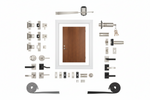
Knowing the correct door parts name for each component matters more than most homeowners expect. Whether you are describing a problem to a contractor, ordering a replacement component, or selecting a new door, using the right terminology saves time and prevents costly misunderstandings. This guide covers every main door parts name and what each component does, and whether it applies to interior doors, exterior doors, or both.
Door parts names fall into three main groups: frame parts (head jamb, side jambs, sill, threshold, casing, and door stop), slab parts (stiles, rails, panels, and mullion), and hardware parts (hinges, handle or lever, latch, lock, strike plate, and escutcheon). Interior doors typically omit the sill and threshold, which are primarily exterior door components.

Why Knowing Door Part Names Matters
Most homeowners only need door terminology when something goes wrong or when they are shopping for a replacement. In both situations, knowing the correct door parts name is the difference between a quick resolution and a frustrating exchange with a contractor, hardware store, or supplier.
When a latch stops catching because the strike plate has shifted, describing it as the metal plate on the frame where the door closes gets the point across immediately. When ordering a prehung unit, understanding the difference between the jamb and the casing prevents the common mistake of ordering the wrong product. For DIY installation or adjustment, knowing that a door stop (the strip inside the jamb) is a completely different component from a doorstop (the rubber wedge on the floor) prevents confusion between two items with similar names but entirely different functions. The door parts name terminology in this guide mirrors what contractors, door suppliers, and hardware stores use in the US market.
Frame Parts: The Structure Around the Door
The door frame is the structural assembly built into the wall opening that holds the door in place. Each component of the frame has a specific name and a specific role. Understanding the frame part names is particularly useful when diagnosing problems with a door that sticks, has visible gaps, or does not close squarely.
|
Part Name |
Location |
Function |
Interior / Exterior |
|
Head jamb (header) |
Top horizontal piece of the frame |
Connects the two side jambs; supports the top of the door opening |
Both |
|
Hinge jamb |
Vertical side jamb where hinges attach |
Bears the full weight of the door slab through the hinges; must remain plumb for smooth swing |
Both |
|
Strike jamb |
Vertical side jamb opposite the hinges |
Houses the strike plate where the latch seats when the door is closed |
Both |
|
Sill |
Bottom horizontal piece at floor level |
Structural base of the frame; supports the threshold |
Exterior mainly |
|
Threshold |
On top of the sill at the bottom of the opening |
Seals the gap between the door bottom and the floor; made of aluminum, bronze, or hardwood |
Exterior mainly |
|
Casing / trim |
Decorative molding on both wall faces |
Covers the gap between the jamb edge and the surrounding drywall |
Both |
|
Door stop (jamb stop) |
Thin strip on the inner face of each jamb |
Prevents the door from swinging through; guides the door into the closed position |
Both |
The hinge jamb and strike jamb are both side jambs but serve opposite functions. The sill and threshold are primarily exterior components; most interior doors do not have them. Casing is decorative, not structural, and is sometimes sold separately from prehung door units.
See more: Door Slab vs Prehung: What's the Difference and Which One Is Right for Your Project?
Slab Parts: The Door Panel Itself
The door slab is the panel that swings open and closed. On panel doors, the slab is made up of several named structural and decorative components. On flush doors, the surface is flat and uniform, with no visible internal divisions.
Panel Door Slab Parts
|
Part Name |
Location |
Function |
|
Stiles |
Full-height vertical members on both sides of the panel |
Form the left and right edges of the door; where hinges and lockset bore are installed |
|
Top rail |
Horizontal piece at the top of the door between the two stiles |
Closes the top of the door structure; narrower rail in most panel door designs |
|
Bottom rail |
Horizontal piece at the bottom between the two stiles |
Closes the bottom; typically the widest rail for structural stability and resistance to warping |
|
Lock rail |
Horizontal piece at handle height between top and bottom rails |
Positioned where the lockset bore is drilled; aligns directly with the strike plate in the frame |
|
Mid rail |
Additional horizontal piece dividing upper and lower sections |
Present on six-panel and multi-panel doors; adds visual division and structural support |
|
Panels |
Sections between the stiles and rails |
Raised or recessed decorative surfaces; can be solid wood, MDF, or glass |
|
Mullion |
Vertical element dividing two adjacent panels in the center |
Separates glass sections or panel areas; can be fixed or removable depending on the door design |
The number of rails in a panel door depends on its design. A two-panel door has a top rail, a bottom rail, and one mid or lock rail. A six-panel door has a top rail, a bottom rail, a lock rail, and additional mid rails dividing the panel sections. Stiles run the full height of the door regardless of the number of panels.

Flush Door Slab Parts
Flush doors have no visible stiles, rails, or panels from the outside. They appear as a completely flat, uniform surface on both faces. Internally they contain a structural frame of stiles and rails, and a core that is either hollow or solid, but neither is visible once the door is assembled. The only visible slab components on a flush door are the face (the smooth surface material on both sides), the edges (where hinges and the lockset are installed), and the top and bottom edges. Knowing this distinction matters when ordering: a six-panel door and a flush door may share identical external dimensions but look and feel entirely different.
Browse interior door parts and hardware at Doors and Beyond: Browse Interior Door Parts at Doors and Beyond
Hardware Parts: What Makes the Door Operate
Door hardware refers to all mechanical and decorative components attached to the door slab and frame that allow it to open, close, and lock. Each hardware component has a specific door parts name that corresponds to its function.
Hinges are among the most important hardware components and are worth understanding in detail. A standard interior door uses two or three hinges depending on its weight and height. The hinges attach to the hinge stile of the door slab and to the hinge jamb of the frame, and they bear the full weight of the door through every open-and-close cycle.
|
Part Name |
Location |
Function |
Interior / Exterior |
|
Hinges |
Hinge stile of slab + hinge jamb of frame |
Allow the door to swing open and closed; bear the full weight of the slab |
Both |
|
Handle / lever |
Mid-height on the door face |
Operated to retract the latch and open the door; lever is easier to operate than a knob |
Both |
|
Knob |
Mid-height on the door face |
Rounded grip that retracts the latch when turned; traditional residential standard |
Both |
|
Latch bolt |
Edge of the door slab at mid-height |
Spring-loaded bolt that seats in the strike plate to hold the door closed when released |
Both |
|
Deadbolt |
Edge of the slab above the latch |
Provides additional security; requires key or thumb turn; does not retract without deliberate action |
Exterior / lockable interior |
|
Strike plate |
Strike jamb at latch height |
Metal plate with opening where latch seats; reinforces the jamb against repeated contact |
Both |
|
Escutcheon / rose |
Door face, around the handle or knob base |
Decorative plate covering the bore hole in the door face; part of the handle set |
Both |
|
Flush bolt |
Top or bottom edge of the inactive door panel |
Slides into the frame to lock one panel of a double door in place without a separate lock |
Both |
|
Door stop / doorstop |
Floor or wall near the door's swing path |
Prevents the door from swinging into the wall; floor-mounted rubber or wall-mounted bumper type |
Both |
The flush bolt is often overlooked but is critical for double door installations. Without a flush bolt securing the inactive panel, the active door cannot latch securely against a stationary panel. The door stop hardware (the rubber bumper) is a different component from the door stop molding (the jamb strip); both share a similar name but serve entirely different functions.
See more: What Is a Flush Bolt for Doors? Types, Uses, and How to Install One

Parts Specific to Exterior Doors
Exterior doors include several components that interior doors do not require, specifically to manage weather resistance, thermal performance, and security. Knowing these exterior-specific door parts names helps when evaluating or replacing entry doors.
The threshold is the most prominent exterior-only component, sealing the gap at the bottom of the door and acting as the first line of defense against drafts, water, and pests. Weatherstripping is a flexible seal applied around the full perimeter of the frame on the door stop molding; it compresses against the door slab when closed to block air and moisture. A door sweep is attached to the bottom edge of the door slab itself and sweeps against the threshold to seal the bottom gap from below.
Sidelights are narrow fixed glass panels installed beside an exterior door to bring natural light into the entryway; they are part of the door surround assembly, not the door slab itself. A transom is a fixed or operable window element above the door opening, again part of the surrounding assembly rather than the door panel.
See more: Rough Opening for Bypass Doors: The Correct Formula, Standard Size Table, and How to Measure
Final Thoughts
Door parts names follow consistent terminology across residential and commercial applications in the US market. Grouping all door parts names into three categories , frame, slab, and hardware , makes the full vocabulary manageable. The frame determines how the door fits the wall; the slab determines how it looks and performs; the hardware determines how it opens, closes, and locks. Knowing each part by name makes every door purchase, repair, and installation conversation about door parts more precise and efficient.
Browse interior door hardware and replacement parts at Doors and Beyond: Browse Door Hardware at Doors and Beyond
Door Parts Name: A Complete Guide to Every Part of a Door, Frame, and Hardware

Knowing the correct door parts name for each component matters more than most homeowners expect. Whether you are describing a problem to a contractor, ordering a replacement component, or selecting a new door, using the right terminology saves time and prevents costly misunderstandings. This guide covers every main door parts name and what each component does, and whether it applies to interior doors, exterior doors, or both.
Door parts names fall into three main groups: frame parts (head jamb, side jambs, sill, threshold, casing, and door stop), slab parts (stiles, rails, panels, and mullion), and hardware parts (hinges, handle or lever, latch, lock, strike plate, and escutcheon). Interior doors typically omit the sill and threshold, which are primarily exterior door components.
Why Knowing Door Part Names Matters
Most homeowners only need door terminology when something goes wrong or when they are shopping for a replacement. In both situations, knowing the correct door parts name is the difference between a quick resolution and a frustrating exchange with a contractor, hardware store, or supplier.
When a latch stops catching because the strike plate has shifted, describing it as the metal plate on the frame where the door closes gets the point across immediately. When ordering a prehung unit, understanding the difference between the jamb and the casing prevents the common mistake of ordering the wrong product. For DIY installation or adjustment, knowing that a door stop (the strip inside the jamb) is a completely different component from a doorstop (the rubber wedge on the floor) prevents confusion between two items with similar names but entirely different functions. The door parts name terminology in this guide mirrors what contractors, door suppliers, and hardware stores use in the US market.
Frame Parts: The Structure Around the Door
The door frame is the structural assembly built into the wall opening that holds the door in place. Each component of the frame has a specific name and a specific role. Understanding the frame part names is particularly useful when diagnosing problems with a door that sticks, has visible gaps, or does not close squarely.
|
Part Name |
Location |
Function |
Interior / Exterior |
|
Head jamb (header) |
Top horizontal piece of the frame |
Connects the two side jambs; supports the top of the door opening |
Both |
|
Hinge jamb |
Vertical side jamb where hinges attach |
Bears the full weight of the door slab through the hinges; must remain plumb for smooth swing |
Both |
|
Strike jamb |
Vertical side jamb opposite the hinges |
Houses the strike plate where the latch seats when the door is closed |
Both |
|
Sill |
Bottom horizontal piece at floor level |
Structural base of the frame; supports the threshold |
Exterior mainly |
|
Threshold |
On top of the sill at the bottom of the opening |
Seals the gap between the door bottom and the floor; made of aluminum, bronze, or hardwood |
Exterior mainly |
|
Casing / trim |
Decorative molding on both wall faces |
Covers the gap between the jamb edge and the surrounding drywall |
Both |
|
Door stop (jamb stop) |
Thin strip on the inner face of each jamb |
Prevents the door from swinging through; guides the door into the closed position |
Both |
The hinge jamb and strike jamb are both side jambs but serve opposite functions. The sill and threshold are primarily exterior components; most interior doors do not have them. Casing is decorative, not structural, and is sometimes sold separately from prehung door units.
See more: Door Slab vs Prehung: What's the Difference and Which One Is Right for Your Project?
Slab Parts: The Door Panel Itself
The door slab is the panel that swings open and closed. On panel doors, the slab is made up of several named structural and decorative components. On flush doors, the surface is flat and uniform, with no visible internal divisions.
Panel Door Slab Parts
|
Part Name |
Location |
Function |
|
Stiles |
Full-height vertical members on both sides of the panel |
Form the left and right edges of the door; where hinges and lockset bore are installed |
|
Top rail |
Horizontal piece at the top of the door between the two stiles |
Closes the top of the door structure; narrower rail in most panel door designs |
|
Bottom rail |
Horizontal piece at the bottom between the two stiles |
Closes the bottom; typically the widest rail for structural stability and resistance to warping |
|
Lock rail |
Horizontal piece at handle height between top and bottom rails |
Positioned where the lockset bore is drilled; aligns directly with the strike plate in the frame |
|
Mid rail |
Additional horizontal piece dividing upper and lower sections |
Present on six-panel and multi-panel doors; adds visual division and structural support |
|
Panels |
Sections between the stiles and rails |
Raised or recessed decorative surfaces; can be solid wood, MDF, or glass |
|
Mullion |
Vertical element dividing two adjacent panels in the center |
Separates glass sections or panel areas; can be fixed or removable depending on the door design |
The number of rails in a panel door depends on its design. A two-panel door has a top rail, a bottom rail, and one mid or lock rail. A six-panel door has a top rail, a bottom rail, a lock rail, and additional mid rails dividing the panel sections. Stiles run the full height of the door regardless of the number of panels.
Flush Door Slab Parts
Flush doors have no visible stiles, rails, or panels from the outside. They appear as a completely flat, uniform surface on both faces. Internally they contain a structural frame of stiles and rails, and a core that is either hollow or solid, but neither is visible once the door is assembled. The only visible slab components on a flush door are the face (the smooth surface material on both sides), the edges (where hinges and the lockset are installed), and the top and bottom edges. Knowing this distinction matters when ordering: a six-panel door and a flush door may share identical external dimensions but look and feel entirely different.
Browse interior door parts and hardware at Doors and Beyond: Browse Interior Door Parts at Doors and Beyond
Hardware Parts: What Makes the Door Operate
Door hardware refers to all mechanical and decorative components attached to the door slab and frame that allow it to open, close, and lock. Each hardware component has a specific door parts name that corresponds to its function.
Hinges are among the most important hardware components and are worth understanding in detail. A standard interior door uses two or three hinges depending on its weight and height. The hinges attach to the hinge stile of the door slab and to the hinge jamb of the frame, and they bear the full weight of the door through every open-and-close cycle.
|
Part Name |
Location |
Function |
Interior / Exterior |
|
Hinges |
Hinge stile of slab + hinge jamb of frame |
Allow the door to swing open and closed; bear the full weight of the slab |
Both |
|
Handle / lever |
Mid-height on the door face |
Operated to retract the latch and open the door; lever is easier to operate than a knob |
Both |
|
Knob |
Mid-height on the door face |
Rounded grip that retracts the latch when turned; traditional residential standard |
Both |
|
Latch bolt |
Edge of the door slab at mid-height |
Spring-loaded bolt that seats in the strike plate to hold the door closed when released |
Both |
|
Deadbolt |
Edge of the slab above the latch |
Provides additional security; requires key or thumb turn; does not retract without deliberate action |
Exterior / lockable interior |
|
Strike plate |
Strike jamb at latch height |
Metal plate with opening where latch seats; reinforces the jamb against repeated contact |
Both |
|
Escutcheon / rose |
Door face, around the handle or knob base |
Decorative plate covering the bore hole in the door face; part of the handle set |
Both |
|
Flush bolt |
Top or bottom edge of the inactive door panel |
Slides into the frame to lock one panel of a double door in place without a separate lock |
Both |
|
Door stop / doorstop |
Floor or wall near the door's swing path |
Prevents the door from swinging into the wall; floor-mounted rubber or wall-mounted bumper type |
Both |
The flush bolt is often overlooked but is critical for double door installations. Without a flush bolt securing the inactive panel, the active door cannot latch securely against a stationary panel. The door stop hardware (the rubber bumper) is a different component from the door stop molding (the jamb strip); both share a similar name but serve entirely different functions.
See more: What Is a Flush Bolt for Doors? Types, Uses, and How to Install One
Parts Specific to Exterior Doors
Exterior doors include several components that interior doors do not require, specifically to manage weather resistance, thermal performance, and security. Knowing these exterior-specific door parts names helps when evaluating or replacing entry doors.
The threshold is the most prominent exterior-only component, sealing the gap at the bottom of the door and acting as the first line of defense against drafts, water, and pests. Weatherstripping is a flexible seal applied around the full perimeter of the frame on the door stop molding; it compresses against the door slab when closed to block air and moisture. A door sweep is attached to the bottom edge of the door slab itself and sweeps against the threshold to seal the bottom gap from below.
Sidelights are narrow fixed glass panels installed beside an exterior door to bring natural light into the entryway; they are part of the door surround assembly, not the door slab itself. A transom is a fixed or operable window element above the door opening, again part of the surrounding assembly rather than the door panel.
See more: Rough Opening for Bypass Doors: The Correct Formula, Standard Size Table, and How to Measure
Final Thoughts
Door parts names follow consistent terminology across residential and commercial applications in the US market. Grouping all door parts names into three categories , frame, slab, and hardware , makes the full vocabulary manageable. The frame determines how the door fits the wall; the slab determines how it looks and performs; the hardware determines how it opens, closes, and locks. Knowing each part by name makes every door purchase, repair, and installation conversation about door parts more precise and efficient.
Browse interior door hardware and replacement parts at Doors and Beyond: Browse Door Hardware at Doors and Beyond


