


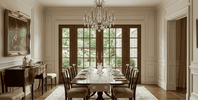
French doors transform a dining room more than almost any other single architectural change. They flood the space with natural light, create a visual connection to the outdoors or an adjacent room, and give the entire area a sense of scale that solid walls cannot replicate. Whether the dining room is large or compact, formal or casual, there is a French door configuration that works for the space.
French doors work exceptionally well in dining rooms. As exterior doors, they open the dining space to a patio or garden and create an indoor-outdoor connection ideal for entertaining. As interior doors, they divide a dining room from an adjacent living or hallway space while maintaining visual flow and natural light between rooms. Both uses suit a wide range of dining room sizes and styles.
Two Ways French Doors Work in a Dining Room
French doors serve two fundamentally different functions in a dining room, and the design decisions that follow depend entirely on which use case applies. Getting this right upfront prevents choosing a door configuration that works against the room rather than for it.
| Use Case | Best For | Door Config | Key Consideration |
|---|---|---|---|
| Exterior: dining room to patio or garden | Indoor-outdoor entertaining; natural light from backyard | Outswing preferred; inswing if patio space is limited | Swing arc must clear dining chairs; consider screen option |
| Interior: dining room divider | Open-plan separation; formal vs casual zone definition | Inswing into larger room; full glass for light flow | Both sides visible - hardware and glass work from both rooms |
| Interior: enclosing an open dining area | Creating a defined formal space in open-plan layout | Inswing or outswing depending on adjacent space | Curtains or privacy film may be needed for certain occasions |
Exterior dining room French doors to a patio are the most common US application. Interior dividers are the better choice when the goal is enclosing a formal dining space within an open-plan layout while keeping visual connection between rooms alive. Outswing configuration suits both use cases whenever swing arc space is tight on the interior side.
See more: What Is a Single French Door? Features, Pros and Cons

Choosing the Right Style for Your Dining Room
French doors come in enough styles, materials, and finishes to work in any dining room aesthetic. The choices that matter most are frame material, glass configuration, and hardware finish, and they should follow the existing design language of the room.
| Dining Room Style | Frame Material | Glass Configuration | Hardware Finish | Color Direction |
|---|---|---|---|---|
| Traditional / formal | Wood (painted or stained) | True divided light, multiple panes | Antique brass, oil-rubbed bronze | White, cream, or dark wood |
| French country / farmhouse | Wood or painted steel | Divided light or single pane | Matte black, unlacquered brass | White, sage green, or warm gray |
| Contemporary / modern | Aluminum or steel | Large single pane per panel | Matte black or brushed nickel | Black, charcoal, or white |
| Transitional | Fiberglass or painted wood | Single pane or minimal grid | Brushed nickel or satin bronze | White, gray, or warm taupe |
| Coastal / relaxed | Painted wood or vinyl | Single pane | Chrome or brushed nickel | White, light blue, or bleached wood |
Traditional and farmhouse dining rooms favor divided-light wood frames. Modern and transitional spaces work best with single large panes and slim aluminum or steel frames. Match the hardware finish to existing fixtures already in the room - chandelier or cabinet pulls are the easiest reference point for a cohesive result.
Furniture Layout Around Dining Room French Doors
The single biggest practical challenge with French doors in a dining room is ensuring the door swing does not conflict with chair placement or traffic flow. Getting the layout right before the doors are installed prevents a situation where the doors cannot open fully in normal use.
The Swing Arc Rule
A standard French door panel swings approximately 30 to 36 inches through its arc. The nearest dining chair must sit beyond that arc so the door can open completely without moving the chair first. For inswing doors, measure that distance from the door plane into the room. For outswing doors, the arc is exterior, but 36 inches of clear interior passage at the threshold is still needed for comfortable daily use.
Small Dining Room Solutions
In a compact dining room where inswing arc space is not available, three alternatives solve the problem without sacrificing the French door look:
- Outswing configuration: moves the swing arc entirely to the exterior, freeing the interior floor plan completely.
- Pocket French doors: slide into the wall on a track and eliminate swing clearance as a concern altogether.
- Bi-fold French-style doors: fold against the wall when open, reducing the effective swing footprint to a fraction of a traditional hinged pair.
All three options allow a small dining room with French doors to function without chair placement or table positioning being constrained by a door arc.
See more: Interior French Door Sizes: Complete Guide to Standard and Custom Dimensions

Window Treatments and Evening Lighting
Window treatments on dining room French doors need to balance privacy during meals with the ability to open the room to light and the outdoor view when privacy is not a concern. The right treatment keeps both options available without making the doors feel dressed-down or obstructed.
Treatment Options by Priority
- Sheer curtains on a wall-mounted rod: hung above the door frame - fabric pushes to both sides when not in use, keeping the full door visible.
- Roman shades or roller shades: mounted directly on the door glass panels - cleaner look, no rod extension needed beyond the door frame.
- Floor-length lined panels: on a ceiling-height rod - most dramatic for formal dining rooms; completely covers glass when drawn for evening privacy.
For all treatments, the rod or mounting hardware should extend 10 to 12 inches beyond each side of the door frame so stacked fabric clears the door completely when open.
The Nighttime Reflection Issue
Large glass panels in a dining room create reflective surfaces after dark, turning the door glass into a mirror once the sun sets. This makes the room feel smaller and darker rather than more open. Two approaches address it directly:
Exterior lighting: at the door - wall sconces on either side or path lighting visible through the glass turns the exterior view into an illuminated backdrop for evening dining.
Interior lighting placement: keep chandeliers or pendant lights positioned away from the door wall to reduce the reflective effect from the inside.
See more: Curtains on French Doors: Ideas by Room, Style and Mounting Method
Final Thoughts
French doors elevate a dining room in a way that is difficult to replicate with any other single change. The key decisions are choosing the right use case, confirming the swing arc works with the furniture layout, and selecting a style that reads as intentional within the room's existing design. When those decisions are made correctly, the doors become the defining feature of the space.
French Doors in the Dining Room: Design Ideas, Layouts, and What Actually Works

French doors transform a dining room more than almost any other single architectural change. They flood the space with natural light, create a visual connection to the outdoors or an adjacent room, and give the entire area a sense of scale that solid walls cannot replicate. Whether the dining room is large or compact, formal or casual, there is a French door configuration that works for the space.
French doors work exceptionally well in dining rooms. As exterior doors, they open the dining space to a patio or garden and create an indoor-outdoor connection ideal for entertaining. As interior doors, they divide a dining room from an adjacent living or hallway space while maintaining visual flow and natural light between rooms. Both uses suit a wide range of dining room sizes and styles.
Two Ways French Doors Work in a Dining Room
French doors serve two fundamentally different functions in a dining room, and the design decisions that follow depend entirely on which use case applies. Getting this right upfront prevents choosing a door configuration that works against the room rather than for it.
| Use Case | Best For | Door Config | Key Consideration |
|---|---|---|---|
| Exterior: dining room to patio or garden | Indoor-outdoor entertaining; natural light from backyard | Outswing preferred; inswing if patio space is limited | Swing arc must clear dining chairs; consider screen option |
| Interior: dining room divider | Open-plan separation; formal vs casual zone definition | Inswing into larger room; full glass for light flow | Both sides visible - hardware and glass work from both rooms |
| Interior: enclosing an open dining area | Creating a defined formal space in open-plan layout | Inswing or outswing depending on adjacent space | Curtains or privacy film may be needed for certain occasions |
Exterior dining room French doors to a patio are the most common US application. Interior dividers are the better choice when the goal is enclosing a formal dining space within an open-plan layout while keeping visual connection between rooms alive. Outswing configuration suits both use cases whenever swing arc space is tight on the interior side.
See more: What Is a Single French Door? Features, Pros and Cons
Choosing the Right Style for Your Dining Room
French doors come in enough styles, materials, and finishes to work in any dining room aesthetic. The choices that matter most are frame material, glass configuration, and hardware finish, and they should follow the existing design language of the room.
| Dining Room Style | Frame Material | Glass Configuration | Hardware Finish | Color Direction |
|---|---|---|---|---|
| Traditional / formal | Wood (painted or stained) | True divided light, multiple panes | Antique brass, oil-rubbed bronze | White, cream, or dark wood |
| French country / farmhouse | Wood or painted steel | Divided light or single pane | Matte black, unlacquered brass | White, sage green, or warm gray |
| Contemporary / modern | Aluminum or steel | Large single pane per panel | Matte black or brushed nickel | Black, charcoal, or white |
| Transitional | Fiberglass or painted wood | Single pane or minimal grid | Brushed nickel or satin bronze | White, gray, or warm taupe |
| Coastal / relaxed | Painted wood or vinyl | Single pane | Chrome or brushed nickel | White, light blue, or bleached wood |
Traditional and farmhouse dining rooms favor divided-light wood frames. Modern and transitional spaces work best with single large panes and slim aluminum or steel frames. Match the hardware finish to existing fixtures already in the room - chandelier or cabinet pulls are the easiest reference point for a cohesive result.
Furniture Layout Around Dining Room French Doors
The single biggest practical challenge with French doors in a dining room is ensuring the door swing does not conflict with chair placement or traffic flow. Getting the layout right before the doors are installed prevents a situation where the doors cannot open fully in normal use.
The Swing Arc Rule
A standard French door panel swings approximately 30 to 36 inches through its arc. The nearest dining chair must sit beyond that arc so the door can open completely without moving the chair first. For inswing doors, measure that distance from the door plane into the room. For outswing doors, the arc is exterior, but 36 inches of clear interior passage at the threshold is still needed for comfortable daily use.
Small Dining Room Solutions
In a compact dining room where inswing arc space is not available, three alternatives solve the problem without sacrificing the French door look:
- Outswing configuration: moves the swing arc entirely to the exterior, freeing the interior floor plan completely.
- Pocket French doors: slide into the wall on a track and eliminate swing clearance as a concern altogether.
- Bi-fold French-style doors: fold against the wall when open, reducing the effective swing footprint to a fraction of a traditional hinged pair.
All three options allow a small dining room with French doors to function without chair placement or table positioning being constrained by a door arc.
See more: Interior French Door Sizes: Complete Guide to Standard and Custom Dimensions
Window Treatments and Evening Lighting
Window treatments on dining room French doors need to balance privacy during meals with the ability to open the room to light and the outdoor view when privacy is not a concern. The right treatment keeps both options available without making the doors feel dressed-down or obstructed.
Treatment Options by Priority
- Sheer curtains on a wall-mounted rod: hung above the door frame - fabric pushes to both sides when not in use, keeping the full door visible.
- Roman shades or roller shades: mounted directly on the door glass panels - cleaner look, no rod extension needed beyond the door frame.
- Floor-length lined panels: on a ceiling-height rod - most dramatic for formal dining rooms; completely covers glass when drawn for evening privacy.
For all treatments, the rod or mounting hardware should extend 10 to 12 inches beyond each side of the door frame so stacked fabric clears the door completely when open.
The Nighttime Reflection Issue
Large glass panels in a dining room create reflective surfaces after dark, turning the door glass into a mirror once the sun sets. This makes the room feel smaller and darker rather than more open. Two approaches address it directly:
Exterior lighting: at the door - wall sconces on either side or path lighting visible through the glass turns the exterior view into an illuminated backdrop for evening dining.
Interior lighting placement: keep chandeliers or pendant lights positioned away from the door wall to reduce the reflective effect from the inside.
See more: Curtains on French Doors: Ideas by Room, Style and Mounting Method
Final Thoughts
French doors elevate a dining room in a way that is difficult to replicate with any other single change. The key decisions are choosing the right use case, confirming the swing arc works with the furniture layout, and selecting a style that reads as intentional within the room's existing design. When those decisions are made correctly, the doors become the defining feature of the space.


