


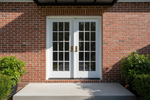
Exterior French doors come in a defined set of standard widths that fit most residential openings without custom work. Knowing which widths are available, how they convert to rough opening dimensions, and which size suits your specific space prevents the most common and most expensive ordering mistake in any door project: getting the dimensions wrong before the door is built.
Exterior French doors for double-door pairs come in standard widths of 60, 72, and 96 inches total, with each panel being half that width. The most common size is 72 inches wide by 80 inches tall. The rough opening must be 2 inches wider and 2.5 inches taller than the door unit to allow for shimming and installation clearance.

Panel Width vs Pair Width: The Most Common Ordering Confusion
Before reviewing any size chart, one distinction must be clear: the width listed for a French door refers to the total unit width, not the width of a single panel. Getting this wrong is the single most common source of ordering errors and one that cannot be corrected after the door is manufactured.
A 72-inch exterior French door pair consists of two panels, each 36 inches wide. When both panels are fully open, the usable passage is the full 72 inches. When ordering, manufacturers and retailers list the total unit width. If a homeowner measures their rough opening at 36 inches and orders a 36-inch French door pair, they will receive a unit that is 36 inches total with two 18-inch panels, which is non-functional for any exterior patio application. Always confirm whether the stated width is per panel or for the full unit before placing any order.
Standard Exterior French Door Widths and Heights
Exterior French doors follow consistent standard widths across most US manufacturers. The available sizes are predictable and easy to plan around, which means most residential openings can be fitted with a standard unit without custom work.
Standard Width and Height Table
|
Total Pair Width |
Per Panel Width |
Standard Heights Available |
Best For |
|
60 inches (5 ft) |
30 in each |
80 in |
Smaller patios, side yards, narrow deck access |
|
72 inches (6 ft) |
36 in each |
80 in, 84 in |
Standard patio or deck — most widely stocked size |
|
96 inches (8 ft) |
48 in each |
80, 84, 96 in |
Wide deck openings, open-plan living to large outdoor areas |
72 inches wide by 80 inches tall is the most commonly stocked exterior French door size in the US and the right default for standard residential patio and deck applications. 60-inch pairs suit tighter wall sections. 96-inch pairs are typically special-order and suit larger openings or high-traffic outdoor entertaining spaces.
Why 60 Inches Is the Practical Minimum
60 inches is the minimum practical width for exterior French patio doors. Below this threshold, each panel is only 30 inches wide, which limits the usable passage on each side and makes moving furniture through the opening awkward in daily use. For an exterior application where the primary function is connecting a living area to a patio or deck, 72 inches is the better starting point. 60 inches is appropriate when wall space constraints make 72 inches structurally difficult or when the opening is replacing a narrow existing window or door that cannot be widened without significant framing work.
Height Options
Standard heights for exterior French doors are 80 inches (6 feet 8 inches), 84 inches (7 feet), and 96 inches (8 feet). 80 inches is the most widely stocked and suits homes with standard 8-foot ceiling heights. 84 and 96-inch heights are proportionally better suited to homes with 9 or 10-foot ceilings where a taller door reads as intentional rather than undersized. Taller doors require a larger structural header above the opening and a correspondingly taller rough opening; confirm both before specifying a non-standard height.
See more: French Doors Width and Dimensions: Complete Size Guide for Interior and Exterior

Rough Opening Dimensions: Pre-Calculated
The rough opening is the framed hole in the wall where the door unit sits, and it is not the same as the door unit size. Ordering a door to fit an existing opening requires knowing both numbers. The table below converts standard door unit dimensions to their required rough opening dimensions so the calculation is done before the order is placed.
|
Door Unit Width |
Rough Opening Width |
Door Unit Height |
Rough Opening Height |
|
60 inches |
62 inches |
80 inches |
82.5 inches |
|
60 inches |
62 inches |
84 inches |
86.5 inches |
|
72 inches |
74 inches |
80 inches |
82.5 inches |
|
72 inches |
74 inches |
84 inches |
86.5 inches |
|
96 inches |
98 inches |
80 inches |
82.5 inches |
|
96 inches |
98 inches |
84 inches |
86.5 inches |
The rule is consistent across all standard sizes: add 2 inches to the door unit width and 2.5 inches to the door unit height to get the required rough opening dimensions. Confusing door unit size with rough opening size is the most common ordering mistake for both standard and custom exterior French doors.
Looking for exterior French doors in standard and custom widths? Browse the full range at Doors and Beyond: Browse French Doors at Doors and Beyond
Which Width Is Right for Your Space?
Knowing what sizes exist is half the answer. The other half is matching the width to the space's function, foot traffic, and wall clearance. The table below maps common residential situations to the recommended door width.
|
Space / Situation |
Recommended Width |
Why |
Notes |
|
Standard residential patio or deck |
72 inches |
Best balance of opening width and framing cost |
Most widely stocked; easiest to source |
|
Smaller side yard or narrow outdoor passage |
60 inches |
Fits tighter wall sections; adequate for daily use |
Minimum practical for exterior patio applications |
|
Open-plan living room to large deck |
96 inches |
Full opening width for high-traffic entertaining |
Usually special-order; confirm lead time |
|
Replacing a standard 72 in sliding glass door |
72 inches |
Matches existing framing; direct swap usually possible |
Confirm rough opening before ordering |
|
New construction with 9 to 10 ft ceilings |
72–96 in at 84–96 in height |
Proportional to taller ceiling heights |
Specify height at time of order |
72 inches is the right default for the majority of US residential patio and deck applications. 60 inches suits constrained wall sections. 96 inches fits larger openings but requires a special order in most cases. When replacing an existing sliding glass door, confirming the rough opening dimensions before ordering ensures the swap is direct with no framing modification needed.
Swing Arc Clearance and Width
Once the width is confirmed, the swing direction determines whether the door arc clears the interior or exterior space. For a standard 72-inch exterior French door pair, the active panel is 36 inches wide and swings through an arc of approximately 34 to 36 inches. Outswing doors move this arc outside, which frees interior floor space but requires unobstructed clearance in front of the door on the exterior. Inswing doors keep the arc inside and restrict furniture placement within the swing zone. Confirm that the required clearance is available on whichever side the doors will open before finalizing the size and swing direction.
See more: Should French Doors Open In or Out? Complete Installation Guide
When Standard Sizes Do Not Work
Standard sizes cover the majority of residential projects, but four specific situations require a custom-width door rather than framing the opening to fit a standard unit.
Custom sizing is necessary when dealing with a masonry or historic wall where the opening cannot be adjusted without major structural work; when designing a very wide exterior opening above 96 inches as a full multi-panel system; when a high-end architectural project specifies an exact width built into the building plans from the start; or when a load-bearing wall situation means modifying the header to reach a standard size would cost more than the custom door premium. Outside these four situations, adjusting the framing to accommodate a standard door is almost always faster and cheaper. Custom exterior French doors typically cost 20 to 50 percent more than standard equivalents and require 4 to 8 weeks of lead time compared to 1 to 2 weeks for in-stock standard sizes. Confirm with your door supplier whether a standard size with modified framing achieves the same result before committing to a custom order.

How to Measure Your Existing Opening
Measure the width of the opening at three points: top, middle, and bottom. Walls and frames are rarely perfectly square, so the three measurements often differ slightly. Always use the smallest width measurement when determining what size door will fit. If the smallest measurement falls within 2 inches of a standard door unit width after accounting for rough opening allowance, a standard door fits without modification. If the opening is significantly wider than a standard size, the framing can be shimmed inward at substantially lower cost than ordering a custom-width unit.
See more: Replacing a Window with French Doors: What Every Homeowner Needs to Know Before Starting
Final Thoughts
Exterior French doors come in standard widths of 60, 72, and 96 inches for double pairs, with 72 inches being the most common and most practical for residential patio access. Confirming the rough opening, understanding the panel-versus-pair distinction, and matching the width to the space's use case prevents the most costly planning errors before the door is ordered.
How Wide Are Exterior French Doors? Standard Widths, Rough Openings, and How to Choose the Right Size

Exterior French doors come in a defined set of standard widths that fit most residential openings without custom work. Knowing which widths are available, how they convert to rough opening dimensions, and which size suits your specific space prevents the most common and most expensive ordering mistake in any door project: getting the dimensions wrong before the door is built.
Exterior French doors for double-door pairs come in standard widths of 60, 72, and 96 inches total, with each panel being half that width. The most common size is 72 inches wide by 80 inches tall. The rough opening must be 2 inches wider and 2.5 inches taller than the door unit to allow for shimming and installation clearance.
Panel Width vs Pair Width: The Most Common Ordering Confusion
Before reviewing any size chart, one distinction must be clear: the width listed for a French door refers to the total unit width, not the width of a single panel. Getting this wrong is the single most common source of ordering errors and one that cannot be corrected after the door is manufactured.
A 72-inch exterior French door pair consists of two panels, each 36 inches wide. When both panels are fully open, the usable passage is the full 72 inches. When ordering, manufacturers and retailers list the total unit width. If a homeowner measures their rough opening at 36 inches and orders a 36-inch French door pair, they will receive a unit that is 36 inches total with two 18-inch panels, which is non-functional for any exterior patio application. Always confirm whether the stated width is per panel or for the full unit before placing any order.
Standard Exterior French Door Widths and Heights
Exterior French doors follow consistent standard widths across most US manufacturers. The available sizes are predictable and easy to plan around, which means most residential openings can be fitted with a standard unit without custom work.
Standard Width and Height Table
|
Total Pair Width |
Per Panel Width |
Standard Heights Available |
Best For |
|
60 inches (5 ft) |
30 in each |
80 in |
Smaller patios, side yards, narrow deck access |
|
72 inches (6 ft) |
36 in each |
80 in, 84 in |
Standard patio or deck — most widely stocked size |
|
96 inches (8 ft) |
48 in each |
80, 84, 96 in |
Wide deck openings, open-plan living to large outdoor areas |
72 inches wide by 80 inches tall is the most commonly stocked exterior French door size in the US and the right default for standard residential patio and deck applications. 60-inch pairs suit tighter wall sections. 96-inch pairs are typically special-order and suit larger openings or high-traffic outdoor entertaining spaces.
Why 60 Inches Is the Practical Minimum
60 inches is the minimum practical width for exterior French patio doors. Below this threshold, each panel is only 30 inches wide, which limits the usable passage on each side and makes moving furniture through the opening awkward in daily use. For an exterior application where the primary function is connecting a living area to a patio or deck, 72 inches is the better starting point. 60 inches is appropriate when wall space constraints make 72 inches structurally difficult or when the opening is replacing a narrow existing window or door that cannot be widened without significant framing work.
Height Options
Standard heights for exterior French doors are 80 inches (6 feet 8 inches), 84 inches (7 feet), and 96 inches (8 feet). 80 inches is the most widely stocked and suits homes with standard 8-foot ceiling heights. 84 and 96-inch heights are proportionally better suited to homes with 9 or 10-foot ceilings where a taller door reads as intentional rather than undersized. Taller doors require a larger structural header above the opening and a correspondingly taller rough opening; confirm both before specifying a non-standard height.
See more: French Doors Width and Dimensions: Complete Size Guide for Interior and Exterior
Rough Opening Dimensions: Pre-Calculated
The rough opening is the framed hole in the wall where the door unit sits, and it is not the same as the door unit size. Ordering a door to fit an existing opening requires knowing both numbers. The table below converts standard door unit dimensions to their required rough opening dimensions so the calculation is done before the order is placed.
|
Door Unit Width |
Rough Opening Width |
Door Unit Height |
Rough Opening Height |
|
60 inches |
62 inches |
80 inches |
82.5 inches |
|
60 inches |
62 inches |
84 inches |
86.5 inches |
|
72 inches |
74 inches |
80 inches |
82.5 inches |
|
72 inches |
74 inches |
84 inches |
86.5 inches |
|
96 inches |
98 inches |
80 inches |
82.5 inches |
|
96 inches |
98 inches |
84 inches |
86.5 inches |
The rule is consistent across all standard sizes: add 2 inches to the door unit width and 2.5 inches to the door unit height to get the required rough opening dimensions. Confusing door unit size with rough opening size is the most common ordering mistake for both standard and custom exterior French doors.
Looking for exterior French doors in standard and custom widths? Browse the full range at Doors and Beyond: Browse French Doors at Doors and Beyond
Which Width Is Right for Your Space?
Knowing what sizes exist is half the answer. The other half is matching the width to the space's function, foot traffic, and wall clearance. The table below maps common residential situations to the recommended door width.
|
Space / Situation |
Recommended Width |
Why |
Notes |
|
Standard residential patio or deck |
72 inches |
Best balance of opening width and framing cost |
Most widely stocked; easiest to source |
|
Smaller side yard or narrow outdoor passage |
60 inches |
Fits tighter wall sections; adequate for daily use |
Minimum practical for exterior patio applications |
|
Open-plan living room to large deck |
96 inches |
Full opening width for high-traffic entertaining |
Usually special-order; confirm lead time |
|
Replacing a standard 72 in sliding glass door |
72 inches |
Matches existing framing; direct swap usually possible |
Confirm rough opening before ordering |
|
New construction with 9 to 10 ft ceilings |
72–96 in at 84–96 in height |
Proportional to taller ceiling heights |
Specify height at time of order |
72 inches is the right default for the majority of US residential patio and deck applications. 60 inches suits constrained wall sections. 96 inches fits larger openings but requires a special order in most cases. When replacing an existing sliding glass door, confirming the rough opening dimensions before ordering ensures the swap is direct with no framing modification needed.
Swing Arc Clearance and Width
Once the width is confirmed, the swing direction determines whether the door arc clears the interior or exterior space. For a standard 72-inch exterior French door pair, the active panel is 36 inches wide and swings through an arc of approximately 34 to 36 inches. Outswing doors move this arc outside, which frees interior floor space but requires unobstructed clearance in front of the door on the exterior. Inswing doors keep the arc inside and restrict furniture placement within the swing zone. Confirm that the required clearance is available on whichever side the doors will open before finalizing the size and swing direction.
See more: Should French Doors Open In or Out? Complete Installation Guide
When Standard Sizes Do Not Work
Standard sizes cover the majority of residential projects, but four specific situations require a custom-width door rather than framing the opening to fit a standard unit.
Custom sizing is necessary when dealing with a masonry or historic wall where the opening cannot be adjusted without major structural work; when designing a very wide exterior opening above 96 inches as a full multi-panel system; when a high-end architectural project specifies an exact width built into the building plans from the start; or when a load-bearing wall situation means modifying the header to reach a standard size would cost more than the custom door premium. Outside these four situations, adjusting the framing to accommodate a standard door is almost always faster and cheaper. Custom exterior French doors typically cost 20 to 50 percent more than standard equivalents and require 4 to 8 weeks of lead time compared to 1 to 2 weeks for in-stock standard sizes. Confirm with your door supplier whether a standard size with modified framing achieves the same result before committing to a custom order.
How to Measure Your Existing Opening
Measure the width of the opening at three points: top, middle, and bottom. Walls and frames are rarely perfectly square, so the three measurements often differ slightly. Always use the smallest width measurement when determining what size door will fit. If the smallest measurement falls within 2 inches of a standard door unit width after accounting for rough opening allowance, a standard door fits without modification. If the opening is significantly wider than a standard size, the framing can be shimmed inward at substantially lower cost than ordering a custom-width unit.
See more: Replacing a Window with French Doors: What Every Homeowner Needs to Know Before Starting
Final Thoughts
Exterior French doors come in standard widths of 60, 72, and 96 inches for double pairs, with 72 inches being the most common and most practical for residential patio access. Confirming the rough opening, understanding the panel-versus-pair distinction, and matching the width to the space's use case prevents the most costly planning errors before the door is ordered.


