


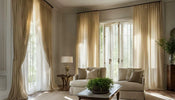
French doors bring in natural light and visual openness, but they also raise questions that regular window curtains never have to answer. The door needs to open freely, privacy matters at different times of day, and the curtain has to work with the door rather than against it. This guide covers the best French door curtain ideas by room type, with a practical comparison table and guidance on mounting, sizing, and fabric choice.
The most effective curtains for French doors are floor-length panels hung on a wall-mounted rod positioned 4 to 6 inches above the door frame and extending 8 to 12 inches beyond each side. This keeps the doors fully clear when open and creates an elegant, full-height look. Sheer panels work best for living areas; lined or blackout panels suit bedrooms and ground-floor privacy needs.
Why French Doors Need a Different Approach Than Regular Windows
A curtain on a standard window only needs to filter light and look good. A curtain on French doors has to do all of that while also allowing the doors to open and close without snagging, bunching, or blocking the swing path. That additional functional constraint is what makes curtains on French doors worth thinking through carefully before purchasing.
The Door Swing Problem
Curtains that are too wide or hung too close to the door frame will catch on the door as it opens. The rod needs to extend far enough on each side that all fabric clears the door when pulled back. Standard extension is 8 to 12 inches beyond the door frame on each side. Inadequate rod extension is by far the most common French door curtain installation mistake, and it is entirely avoidable with a tape measure and a few minutes of planning before purchasing hardware.
Interior French Doors vs Exterior Patio French Doors
Interior room dividers need curtains that look good from both sides and typically call for lighter, unlined fabrics that read as intentional decor in both rooms they connect. Exterior patio French doors face a more demanding set of requirements: direct sunlight exposure fades fabric over time, the doors are used more frequently which means the curtain needs to clear the swing completely each time, and in most US climates thermal or blackout lining adds meaningful energy efficiency by reducing drafts at one of the weakest points in an exterior wall.

Curtain Ideas by Room Type
The best curtains on French doors ideas depend more on which room the doors are in than on any single design preference. Privacy needs, light requirements, and how often the doors are used all vary significantly by room. The table below provides a room-by-room reference for style, fabric, opacity, and mounting before the sections that follow explore each room in more detail.
Room-by-Room Comparison
| Room | Recommended Style | Fabric | Opacity | Mounting |
|---|---|---|---|---|
| Living room | Floor-length panels or sheers | Linen, cotton, sheer voile | Light-filtering to semi-sheer | Wall rod above frame, extended wide |
| Bedroom | Blackout panels or layered sheer + lined | Velvet, linen, cotton + blackout lining | Full blackout | Outside mount, rod extended 10-12 in. |
| Dining room | Tailored floor-length panels | Silk, linen blend, cotton | Semi-opaque | Wall rod or ceiling track |
| Kitchen / breakfast nook | Cafe curtains (lower half only) | Cotton, linen, lightweight poly | Semi-sheer | Inside mount, sash rods on door |
| Home office | Tailored panels or Roman shades | Cotton, light linen | Light-filtering | Outside mount or door-mounted |
| Interior room divider | Lightweight panels, sheer, or voile | Voile, sheer, soft linen | Sheer to semi-sheer | Ceiling track or wall rod above frame |
Living rooms and dining rooms generally prioritize aesthetics and light over privacy, making semi-sheer and linen panels the most common choice. Bedrooms call for the most functional treatment, with blackout lining or layered setups delivering full privacy and darkness. Kitchens and breakfast nooks work well with cafe curtains mounted directly on the door, which cover only the lower glass panels and stay out of the way when the doors open. Interior room dividers need fabrics that look intentional from both sides.
Living Room French Door Curtain Ideas
Living rooms prioritize the view and natural light over privacy in most homes, which makes sheer linen panels or light cotton in neutral tones the most natural fit for curtains on French doors. Hanging the rod high and extending it wide creates the illusion of taller ceilings and more expansive doors, even on standard-height French doors. Tiebacks let the doors function freely throughout the day while keeping the fabric framed elegantly on each side. For living rooms that face a neighbor or a street, a double-rod setup with a sheer and a semi-opaque panel gives flexibility across the day without committing to full blackout darkness.
Bedroom French Door Curtain Ideas
Bedrooms need two things that living rooms often do not: reliable privacy and the ability to block out light when needed. Blackout-lined panels or a layered sheer plus blackout setup on a double rod gives full flexibility across the day, with sheers alone during daylight hours and the heavier panel pulled across at night or for afternoon naps. Velvet and heavy cotton both add meaningful insulation value in winter months, particularly on exterior patio French doors where glass is the weakest insulating surface in the wall. Ensure the rod extends far enough that opening both doors onto a garden or balcony does not drag the curtain fabric through the threshold.
Kitchen and Dining Room French Door Curtain Ideas
Kitchens and breakfast nooks benefit from cafe curtains mounted directly on the door with sash rods. These cover only the lower half of the glass panels, providing counter-height privacy while leaving the upper panes completely open for natural light. Since the curtains are mounted on the door rather than the wall, they move with the door and never block the swing path. For dining rooms, the tone shifts toward the more tailored end of the spectrum, with floor-length linen blend or cotton panels on a wall-mounted rod working well alongside dining furniture that benefits from the visual softness of fabric framing the view.

See more: Should Patio Doors Swing In or Out? What Homeowners Need to Know
Curtain Styles That Work Best on French Doors
Beyond room type, the curtain style itself determines how the doors look and function on a daily basis. Some styles are designed specifically for French door curtain ideas; others are adapted from window treatments that work well with minor hardware adjustments.
Floor-Length Panels
Floor-length panels are the most versatile curtain style for French doors and work well in almost every room. Mounted on a rod above the frame and pulled fully to each side when the doors are in use, they create the most visually complete treatment. The key requirement is adequate rod length and clear wall space on both sides for the fabric to stack without touching the door. For most standard French door widths, a rod that extends 10 to 12 inches beyond each side of the door frame provides enough clearance for the full fabric stack.
Cafe Curtains
Cafe curtains cover only the lower half of the door glass and are the most practical choice for high-traffic door locations like kitchen French doors and ground-floor rooms where lower-level privacy is the main concern. Mounted directly on each door panel using sash rods at the top and bottom of the lower panes, they move with the door when it opens and never obstruct the swing path. Lightweight cotton and linen work best for this style, both for ease of installation and to avoid adding weight to the door that could stress the hinges over time.
Sheer Panels and Layered Treatments
Sheers alone are the right choice for rooms where light diffusion is the primary goal and privacy is a secondary concern, such as sunrooms, formal living rooms, or spaces where the French doors frame a garden view. Layering a sheer panel with a lined or blackout panel on a double rod system is the most flexible French door curtain approach available, allowing full light and a clear view during the day, filtered light through the sheer in the early morning or evening, and complete privacy and darkness when both panels are drawn.
Door-Mounted Curtains with Sash Rods
Door-mounted curtains attach directly to each door panel using tension rods or sash rods, with one rod at the top and one at the bottom of the glass area to hold the fabric taut. This is the classic approach for French door curtain ideas in smaller spaces and is the most practical option for rental properties, spaces with limited wall clearance on either side of the door, or any room where a wall-mounted rod would disrupt an adjacent window or architectural feature. The firm rule with this style is to use lightweight fabric only, as heavy materials add significant weight to the door and will eventually cause hinge alignment problems.

Choosing the Right Fabric
Fabric determines how a curtain hangs, how much light it filters, how it holds up to daily use near an operating door, and whether it complements the room visually. The table below summarizes the most common fabric choices for French doors curtains ideas alongside their key characteristics.
Fabric Comparison at a Glance
| Fabric | Look | Light Control | Best Room Use | Key Note |
|---|---|---|---|---|
| Sheer voile | Airy, romantic | Very light filtering | Living room, sunroom | Low privacy; best layered with opaque panel |
| Linen | Natural, relaxed | Light to semi-opaque | Living room, bedroom, dining | Wrinkles naturally; adds warmth and texture |
| Cotton | Classic, versatile | Semi-opaque | Kitchen, office, casual spaces | Durable and easy to wash; widely available |
| Velvet | Luxurious, formal | Full opacity | Bedroom, formal dining | Heavy; excellent insulation; not for door-mount |
| Silk / faux silk | Dressy, luminous | Semi-opaque | Dining room, formal living | Needs lining on exterior doors to prevent fade |
| Blackout-lined panel | Any fabric face | Full blackout | Bedroom, media room | Layer with sheer on double rod for flexibility |
Linen and cotton are the most versatile choices for the widest range of rooms and work well with both outside-mount and door-mount approaches. Velvet and silk belong in formal spaces and should never be door-mounted due to their weight. Blackout-lined panels are essential for bedrooms and sun-facing rooms, and perform best when paired with a sheer on a double rod rather than used alone.
When Lining Matters
Unlined curtains are appropriate for interior room dividers, light casual spaces, and any situation where the curtain will be visible from both sides and needs to look intentional on each. Privacy lining adds body and structure to the panel and blocks partial light without full blackout effect, making it a good middle ground for living rooms and dining rooms. Blackout lining is the right choice for bedrooms, rooms with direct west or east sun exposure, and exterior patio French doors in climates where drafts are a concern. Thermal lining, which is thicker than standard blackout, also reduces heat transfer at the glass surface and is particularly relevant on exterior patio French doors where the door unit itself is a known weak point for energy efficiency.
See more: Are French Doors More Secure Than Sliding Doors? A Full Comparison
Looking to upgrade the French doors themselves? Browse the full collection at Doors and Beyond: Shop French Doors at Doors and Beyond

Mounting Methods Explained
How curtains are mounted on French doors affects how the doors function, how much wall space is needed, and how the finished result looks. There are three practical mounting approaches, and each suits a different set of circumstances.
Mounting Method Comparison
| Method | Description | Best For | Hardware Needed | Key Consideration |
|---|---|---|---|---|
| Door-mounted sash rods | Rods attach to each door panel; curtain moves with door | Kitchens, rentals, limited wall space | Tension rods or sash rods | Lightweight fabric only; curtain moves when door opens |
| Wall rod above frame | Standard rod mounted 4-6 in. above door frame on wall | Most rooms; all curtain styles | Wall-mount rod with extended brackets | Rod must extend 8-12 in. past each side of door |
| Ceiling-mounted track | Track attached to ceiling directly above the door opening | Wide openings, room dividers, formal spaces | Ceiling track system | Cleanest finish; highest installation effort |
Door-mounted sash rods are the simplest option and require no wall installation, but they limit fabric choice to lightweight materials and the curtain moves each time the door opens. A wall rod above the frame is the most common method and works with the widest range of curtain styles. Ceiling-mounted tracks deliver the cleanest, most architectural finish and are the best option for very wide openings or interior room dividers where a visible wall rod would look out of place.

The Stack-Back Rule Every Homeowner Should Know
When curtains are pulled open, the gathered fabric sits in a compressed stack on each side of the door. That stack must clear the door completely so the door can swing open and close without dragging across the fabric. To calculate the rod length needed, take the total door width and add 8 to 12 inches on each side for the stack, plus another 2 to 3 inches of margin on each side. For a standard 60-inch French door pair, the minimum rod length is approximately 96 to 108 inches total. If the available wall space on either side is narrow, a ceiling-mounted track is a better alternative than trying to compress a full curtain stack into inadequate space. Curtains that press against the door face undermine both the function and the elegance that French door curtain ideas are meant to deliver.
Sizing Your Curtains Correctly
Getting the size right prevents the two outcomes homeowners most want to avoid: curtains that look skimpy and undersized against the full height of French doors, and curtains that drag heavily across the floor or catch on the door threshold. Both problems are avoidable with accurate measurements before purchasing.

Width: The Fullness Formula
Total curtain width should be 1.5 to 2 times the combined width of both doors. For a standard 60-inch French door pair, that means ordering between 90 and 120 inches of total curtain width distributed across however many panels the design uses. More fullness creates richer, more gathered folds when the curtains are closed and a more substantial look when they are pulled to the sides. Curtains ordered at exactly door width with no additional fullness will look flat and insufficient regardless of fabric quality or style.
Length: The Floor Clearance Rule
Floor-length curtains should end between 0.5 and 1 inch above the floor for a clean, tailored finish that reads as intentional rather than too short. A slight puddle of 1 to 2 inches of extra length creates a more dramatic, formal look that suits dining rooms and bedrooms particularly well. What to avoid is any length that falls noticeably short of the floor, as this makes the curtains appear undersized and the room feel lower than it is. Mounting the rod as close to the ceiling as the door frame allows and using floor-to-ceiling panels creates the strongest vertical effect in rooms with standard 8-foot ceilings.
See more: Interior French Door Sizes: Complete Guide to Standard and Custom Dimensions
Final Thoughts
Curtains on French doors work best when the choice is driven by how the room actually functions rather than by style alone. Starting with room type narrows down fabric, opacity, and mounting method quickly, and getting the sizing and stack-back clearance right from the start prevents the most common installation problems. The right curtain frames the doors without fighting them and makes both the room and the doors look better for it.
Looking for French doors worth dressing up? Browse the full range at Doors and Beyond: Shop French Doors at Doors and Beyond
Curtains on French Doors: Ideas by Room, Style, and Mounting Method

French doors bring in natural light and visual openness, but they also raise questions that regular window curtains never have to answer. The door needs to open freely, privacy matters at different times of day, and the curtain has to work with the door rather than against it. This guide covers the best French door curtain ideas by room type, with a practical comparison table and guidance on mounting, sizing, and fabric choice.
The most effective curtains for French doors are floor-length panels hung on a wall-mounted rod positioned 4 to 6 inches above the door frame and extending 8 to 12 inches beyond each side. This keeps the doors fully clear when open and creates an elegant, full-height look. Sheer panels work best for living areas; lined or blackout panels suit bedrooms and ground-floor privacy needs.
Why French Doors Need a Different Approach Than Regular Windows
A curtain on a standard window only needs to filter light and look good. A curtain on French doors has to do all of that while also allowing the doors to open and close without snagging, bunching, or blocking the swing path. That additional functional constraint is what makes curtains on French doors worth thinking through carefully before purchasing.
The Door Swing Problem
Curtains that are too wide or hung too close to the door frame will catch on the door as it opens. The rod needs to extend far enough on each side that all fabric clears the door when pulled back. Standard extension is 8 to 12 inches beyond the door frame on each side. Inadequate rod extension is by far the most common French door curtain installation mistake, and it is entirely avoidable with a tape measure and a few minutes of planning before purchasing hardware.
Interior French Doors vs Exterior Patio French Doors
Interior room dividers need curtains that look good from both sides and typically call for lighter, unlined fabrics that read as intentional decor in both rooms they connect. Exterior patio French doors face a more demanding set of requirements: direct sunlight exposure fades fabric over time, the doors are used more frequently which means the curtain needs to clear the swing completely each time, and in most US climates thermal or blackout lining adds meaningful energy efficiency by reducing drafts at one of the weakest points in an exterior wall.
Curtain Ideas by Room Type
The best curtains on French doors ideas depend more on which room the doors are in than on any single design preference. Privacy needs, light requirements, and how often the doors are used all vary significantly by room. The table below provides a room-by-room reference for style, fabric, opacity, and mounting before the sections that follow explore each room in more detail.
Room-by-Room Comparison
| Room | Recommended Style | Fabric | Opacity | Mounting |
|---|---|---|---|---|
| Living room | Floor-length panels or sheers | Linen, cotton, sheer voile | Light-filtering to semi-sheer | Wall rod above frame, extended wide |
| Bedroom | Blackout panels or layered sheer + lined | Velvet, linen, cotton + blackout lining | Full blackout | Outside mount, rod extended 10-12 in. |
| Dining room | Tailored floor-length panels | Silk, linen blend, cotton | Semi-opaque | Wall rod or ceiling track |
| Kitchen / breakfast nook | Cafe curtains (lower half only) | Cotton, linen, lightweight poly | Semi-sheer | Inside mount, sash rods on door |
| Home office | Tailored panels or Roman shades | Cotton, light linen | Light-filtering | Outside mount or door-mounted |
| Interior room divider | Lightweight panels, sheer, or voile | Voile, sheer, soft linen | Sheer to semi-sheer | Ceiling track or wall rod above frame |
Living rooms and dining rooms generally prioritize aesthetics and light over privacy, making semi-sheer and linen panels the most common choice. Bedrooms call for the most functional treatment, with blackout lining or layered setups delivering full privacy and darkness. Kitchens and breakfast nooks work well with cafe curtains mounted directly on the door, which cover only the lower glass panels and stay out of the way when the doors open. Interior room dividers need fabrics that look intentional from both sides.
Living Room French Door Curtain Ideas
Living rooms prioritize the view and natural light over privacy in most homes, which makes sheer linen panels or light cotton in neutral tones the most natural fit for curtains on French doors. Hanging the rod high and extending it wide creates the illusion of taller ceilings and more expansive doors, even on standard-height French doors. Tiebacks let the doors function freely throughout the day while keeping the fabric framed elegantly on each side. For living rooms that face a neighbor or a street, a double-rod setup with a sheer and a semi-opaque panel gives flexibility across the day without committing to full blackout darkness.
Bedroom French Door Curtain Ideas
Bedrooms need two things that living rooms often do not: reliable privacy and the ability to block out light when needed. Blackout-lined panels or a layered sheer plus blackout setup on a double rod gives full flexibility across the day, with sheers alone during daylight hours and the heavier panel pulled across at night or for afternoon naps. Velvet and heavy cotton both add meaningful insulation value in winter months, particularly on exterior patio French doors where glass is the weakest insulating surface in the wall. Ensure the rod extends far enough that opening both doors onto a garden or balcony does not drag the curtain fabric through the threshold.
Kitchen and Dining Room French Door Curtain Ideas
Kitchens and breakfast nooks benefit from cafe curtains mounted directly on the door with sash rods. These cover only the lower half of the glass panels, providing counter-height privacy while leaving the upper panes completely open for natural light. Since the curtains are mounted on the door rather than the wall, they move with the door and never block the swing path. For dining rooms, the tone shifts toward the more tailored end of the spectrum, with floor-length linen blend or cotton panels on a wall-mounted rod working well alongside dining furniture that benefits from the visual softness of fabric framing the view.
See more: Should Patio Doors Swing In or Out? What Homeowners Need to Know
Curtain Styles That Work Best on French Doors
Beyond room type, the curtain style itself determines how the doors look and function on a daily basis. Some styles are designed specifically for French door curtain ideas; others are adapted from window treatments that work well with minor hardware adjustments.
Floor-Length Panels
Floor-length panels are the most versatile curtain style for French doors and work well in almost every room. Mounted on a rod above the frame and pulled fully to each side when the doors are in use, they create the most visually complete treatment. The key requirement is adequate rod length and clear wall space on both sides for the fabric to stack without touching the door. For most standard French door widths, a rod that extends 10 to 12 inches beyond each side of the door frame provides enough clearance for the full fabric stack.
Cafe Curtains
Cafe curtains cover only the lower half of the door glass and are the most practical choice for high-traffic door locations like kitchen French doors and ground-floor rooms where lower-level privacy is the main concern. Mounted directly on each door panel using sash rods at the top and bottom of the lower panes, they move with the door when it opens and never obstruct the swing path. Lightweight cotton and linen work best for this style, both for ease of installation and to avoid adding weight to the door that could stress the hinges over time.
Sheer Panels and Layered Treatments
Sheers alone are the right choice for rooms where light diffusion is the primary goal and privacy is a secondary concern, such as sunrooms, formal living rooms, or spaces where the French doors frame a garden view. Layering a sheer panel with a lined or blackout panel on a double rod system is the most flexible French door curtain approach available, allowing full light and a clear view during the day, filtered light through the sheer in the early morning or evening, and complete privacy and darkness when both panels are drawn.
Door-Mounted Curtains with Sash Rods
Door-mounted curtains attach directly to each door panel using tension rods or sash rods, with one rod at the top and one at the bottom of the glass area to hold the fabric taut. This is the classic approach for French door curtain ideas in smaller spaces and is the most practical option for rental properties, spaces with limited wall clearance on either side of the door, or any room where a wall-mounted rod would disrupt an adjacent window or architectural feature. The firm rule with this style is to use lightweight fabric only, as heavy materials add significant weight to the door and will eventually cause hinge alignment problems.
Choosing the Right Fabric
Fabric determines how a curtain hangs, how much light it filters, how it holds up to daily use near an operating door, and whether it complements the room visually. The table below summarizes the most common fabric choices for French doors curtains ideas alongside their key characteristics.
Fabric Comparison at a Glance
| Fabric | Look | Light Control | Best Room Use | Key Note |
|---|---|---|---|---|
| Sheer voile | Airy, romantic | Very light filtering | Living room, sunroom | Low privacy; best layered with opaque panel |
| Linen | Natural, relaxed | Light to semi-opaque | Living room, bedroom, dining | Wrinkles naturally; adds warmth and texture |
| Cotton | Classic, versatile | Semi-opaque | Kitchen, office, casual spaces | Durable and easy to wash; widely available |
| Velvet | Luxurious, formal | Full opacity | Bedroom, formal dining | Heavy; excellent insulation; not for door-mount |
| Silk / faux silk | Dressy, luminous | Semi-opaque | Dining room, formal living | Needs lining on exterior doors to prevent fade |
| Blackout-lined panel | Any fabric face | Full blackout | Bedroom, media room | Layer with sheer on double rod for flexibility |
Linen and cotton are the most versatile choices for the widest range of rooms and work well with both outside-mount and door-mount approaches. Velvet and silk belong in formal spaces and should never be door-mounted due to their weight. Blackout-lined panels are essential for bedrooms and sun-facing rooms, and perform best when paired with a sheer on a double rod rather than used alone.
When Lining Matters
Unlined curtains are appropriate for interior room dividers, light casual spaces, and any situation where the curtain will be visible from both sides and needs to look intentional on each. Privacy lining adds body and structure to the panel and blocks partial light without full blackout effect, making it a good middle ground for living rooms and dining rooms. Blackout lining is the right choice for bedrooms, rooms with direct west or east sun exposure, and exterior patio French doors in climates where drafts are a concern. Thermal lining, which is thicker than standard blackout, also reduces heat transfer at the glass surface and is particularly relevant on exterior patio French doors where the door unit itself is a known weak point for energy efficiency.
See more: Are French Doors More Secure Than Sliding Doors? A Full Comparison
Looking to upgrade the French doors themselves? Browse the full collection at Doors and Beyond: Shop French Doors at Doors and Beyond
Mounting Methods Explained
How curtains are mounted on French doors affects how the doors function, how much wall space is needed, and how the finished result looks. There are three practical mounting approaches, and each suits a different set of circumstances.
Mounting Method Comparison
| Method | Description | Best For | Hardware Needed | Key Consideration |
|---|---|---|---|---|
| Door-mounted sash rods | Rods attach to each door panel; curtain moves with door | Kitchens, rentals, limited wall space | Tension rods or sash rods | Lightweight fabric only; curtain moves when door opens |
| Wall rod above frame | Standard rod mounted 4-6 in. above door frame on wall | Most rooms; all curtain styles | Wall-mount rod with extended brackets | Rod must extend 8-12 in. past each side of door |
| Ceiling-mounted track | Track attached to ceiling directly above the door opening | Wide openings, room dividers, formal spaces | Ceiling track system | Cleanest finish; highest installation effort |
Door-mounted sash rods are the simplest option and require no wall installation, but they limit fabric choice to lightweight materials and the curtain moves each time the door opens. A wall rod above the frame is the most common method and works with the widest range of curtain styles. Ceiling-mounted tracks deliver the cleanest, most architectural finish and are the best option for very wide openings or interior room dividers where a visible wall rod would look out of place.
The Stack-Back Rule Every Homeowner Should Know
When curtains are pulled open, the gathered fabric sits in a compressed stack on each side of the door. That stack must clear the door completely so the door can swing open and close without dragging across the fabric. To calculate the rod length needed, take the total door width and add 8 to 12 inches on each side for the stack, plus another 2 to 3 inches of margin on each side. For a standard 60-inch French door pair, the minimum rod length is approximately 96 to 108 inches total. If the available wall space on either side is narrow, a ceiling-mounted track is a better alternative than trying to compress a full curtain stack into inadequate space. Curtains that press against the door face undermine both the function and the elegance that French door curtain ideas are meant to deliver.
Sizing Your Curtains Correctly
Getting the size right prevents the two outcomes homeowners most want to avoid: curtains that look skimpy and undersized against the full height of French doors, and curtains that drag heavily across the floor or catch on the door threshold. Both problems are avoidable with accurate measurements before purchasing.
Width: The Fullness Formula
Total curtain width should be 1.5 to 2 times the combined width of both doors. For a standard 60-inch French door pair, that means ordering between 90 and 120 inches of total curtain width distributed across however many panels the design uses. More fullness creates richer, more gathered folds when the curtains are closed and a more substantial look when they are pulled to the sides. Curtains ordered at exactly door width with no additional fullness will look flat and insufficient regardless of fabric quality or style.
Length: The Floor Clearance Rule
Floor-length curtains should end between 0.5 and 1 inch above the floor for a clean, tailored finish that reads as intentional rather than too short. A slight puddle of 1 to 2 inches of extra length creates a more dramatic, formal look that suits dining rooms and bedrooms particularly well. What to avoid is any length that falls noticeably short of the floor, as this makes the curtains appear undersized and the room feel lower than it is. Mounting the rod as close to the ceiling as the door frame allows and using floor-to-ceiling panels creates the strongest vertical effect in rooms with standard 8-foot ceilings.
See more: Interior French Door Sizes: Complete Guide to Standard and Custom Dimensions
Final Thoughts
Curtains on French doors work best when the choice is driven by how the room actually functions rather than by style alone. Starting with room type narrows down fabric, opacity, and mounting method quickly, and getting the sizing and stack-back clearance right from the start prevents the most common installation problems. The right curtain frames the doors without fighting them and makes both the room and the doors look better for it.
Looking for French doors worth dressing up? Browse the full range at Doors and Beyond: Shop French Doors at Doors and Beyond


