


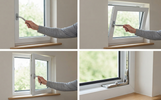
To open a tilt and turn window, start with the handle straight down. Rotate 90 degrees to horizontal for tilt mode, where the top tips inward for ventilation. Rotate 180 degrees to upright for turn mode, where the full sash swings inward. Always close the window completely before repositioning the handle, or the built-in safety mechanism will engage and lock the system.
Tilt and turn windows are common in European construction but still unfamiliar to many US homeowners encountering them for the first time. The single handle controls two completely different opening modes, and using it out of sequence can lock the mechanism in seconds. This guide covers the correct handle positions, how to enter each mode, how to close properly, and what to do if the window gets stuck.

The Three Handle Positions You Need to Know
All operation of a tilt and turn window runs through three fixed handle positions. There are no in-between settings. The handle either sits in one of the three defined positions or it is being rotated between them. If you are new to this type of window and want context on how it differs from standard US casement windows, this comparison of tilt and turn windows vs casement covers the key differences in full.
|
Position |
Handle Direction |
Window State |
When to Use |
|---|---|---|---|
|
Closed |
Straight down (6 o'clock) |
Fully sealed and locked |
Overnight, rain, security |
|
Tilt mode |
Horizontal (9 or 3 o'clock) |
Top tips inward ~4 inches |
Safe ventilation, light rain OK |
|
Turn mode |
Straight up (12 o'clock) |
Full sash swings inward |
Cleaning, max airflow, egress |
The handle rotates clockwise from 6 o'clock (closed) to 3 o'clock (tilt) to 12 o'clock (turn), then counterclockwise back to close. The same multipoint locking system found in our European patio doors uses this sequence -- locking engages automatically each time the handle returns to the closed position.
The same multipoint locking engineering used in tilt and turn windows is standard across our European patio doors collection, where the closing sequence locks the sash at multiple points simultaneously without a separate deadbolt.
How to Open in Tilt Mode (Safe Ventilation)
Tilt mode is the ventilation setting. Only the top of the sash moves, tipping inward by about 4 inches while the bottom stays fixed to the frame. This is the mode to use for overnight ventilation, rooms with young children, or any situation where you want airflow without fully opening the window. Light rain will not enter because the inward angle causes water to run away from the opening.
To open in tilt mode:
- Confirm the window is fully closed. All four edges of the sash should sit flush against the frame before touching the handle.
- Grip the handle and rotate 90 degrees to the horizontal position (3 o'clock if the hinge is on the right; 9 o'clock if on the left).
- Pull the top of the sash gently toward you. It will tip inward and stop automatically at approximately 4 inches.
- Tilt mode is now active. The bottom of the sash remains mechanically fixed. The window cannot be pushed further open from outside.
The 4-inch stop point is a deliberate safety feature, not a hardware fault. In tilt mode, the bottom of the sash is locked in the frame perimeter, which means the window cannot be forced open from outside even when left unattended. This is why tilt mode is the recommended setting for overnight and unattended ventilation on any floor.
Read more: Are French Doors More Secure Than Sliding Doors - A Full Comparison

How to Open in Turn Mode (Full Inward Swing)
Turn mode opens the full sash inward like a door, swinging on the side hinges. This delivers maximum airflow, gives complete access to both faces of the glass for cleaning from inside the room, and qualifies as an egress opening when the window is designated as an emergency exit point.
To open in turn mode:
- Start from the fully closed position with the handle straight down. The sash must be completely seated against the frame before rotating the handle.
- Rotate the handle 180 degrees from straight down to straight up, passing through the horizontal position on the way. Do not stop at horizontal -- continue the full rotation.
- Pull the sash toward you. The full sash swings inward from the side hinges and opens to approximately 90 degrees.
- Step clear of the swing path before opening, particularly with larger sash sizes where the inward swing covers more floor area.
The handle passes through the 90-degree tilt position on the way to 180 degrees. The window will not tilt open during this rotation as long as the sash started from fully closed. The mishandling device, which is described in detail in the Common Mistakes section below, only engages when the handle is moved while the sash is already in motion or only partially closed.

How to Close a Tilt and Turn Window Correctly
Closing correctly matters as much as opening. A window that appears closed but is not fully seated against the frame will not engage the multi-point lock properly, and rotating the handle before the sash is home is the leading cause of mechanism lockouts.
Closing from Tilt Mode
Push the top of the sash back to the fully closed position. Check that all four edges sit flush with the frame. Rotate the handle 90 degrees counterclockwise back to the straight-down position. The multi-point locking system engages as the handle reaches the 6 o'clock position, pressing the sash against the compression seal at multiple points simultaneously.
Closing from Turn Mode
Pull the sash back to the frame and push it home at all four corners. This step is more important coming from turn mode than from tilt, because the full inward swing allows the sash to drift slightly from the frame if not actively held closed. Rotate the handle from straight up, through horizontal, all the way back to straight down. Confirm the handle is fully in the downward position before stepping away from the window.
Critical rule: The handle and the sash must always be in matching positions. A closed handle means a fully closed sash. Rotating the handle while the sash is even slightly ajar, at any stage, will trigger the mishandling device and lock the system until manually reset.

Common Mistakes That Damage the Mechanism
Most tilt and turn window problems reported by first-time US users trace back to the same three errors. Knowing them in advance prevents the frustration of a locked window and the cost of unnecessary repairs.
The first is forcing the handle between positions. The handle has three defined positions and rotates only when the sash is correctly seated. If the handle resists rotation, the window is not fully closed. Applying force strips the internal gearing and breaks the connection between the handle and the locking points. Gentle repositioning of the sash is always the right first step, never force.
The second is switching directly from tilt mode to turn mode without returning to closed. Some users try to rotate the handle past 90 degrees while the window is already tilted open. This triggers the mishandling device, a built-in safety mechanism that prevents the window from entering both modes simultaneously. Once triggered, the handle will not move until the device is manually reset. The window must return to fully closed before any mode change.
The third is not fully seating the sash before locking. The multi-point lock engages around the full perimeter of the sash. If even one corner is not flush with the frame, the locking pin on that edge will not seat in its keep plate, leaving the window appearing to be locked while it is not. On windows with compression rubber seals, a correctly locked window will feel slightly firm to push inward.
Read more: How to Adjust Tilt and Turn Windows - A Complete Step-by-Step Guide
What to Do If Your Window Gets Stuck
A stuck tilt and turn window is almost always caused by the mishandling device engaging, not by a mechanical failure. This built-in safety component prevents the window from being in tilt and turn modes at the same time. When it triggers, the handle locks in position until the device is manually reset. The fix is straightforward once you know where the release component is.

Stuck in Tilt Mode and Will Not Close
Push the top corner of the sash firmly toward the frame at the hinge side to re-seat it as fully as possible. Locate the release button or spring-loaded tab, typically a small component on the inside face of the sash edge just below the handle. Press and hold the release. While holding it, rotate the handle upward to the horizontal or upright position. Release the button. Now pull the sash fully open into turn mode. From turn mode, close the window completely and rotate the handle to the closed position.
Handle Will Not Rotate at All
The sash is almost certainly not fully seated in the frame. Check all four edges for visible gaps, particularly the bottom two corners. Push each corner gently against the frame surface. Once the sash is fully home, the handle should rotate without resistance. If the handle still resists after the sash appears flush, check whether any debris or paint buildup is preventing the sash from seating at the top corners.
Sash Drops or Sits at an Angle When Open
This is a hinge issue rather than a mishandling device issue. A loose or worn hinge allows the sash to sag under its own weight when in turn mode. Do not attempt to force the window closed or rotate the handle with the sash sitting at an angle. This scenario requires hinge adjustment or hinge replacement. If sash drop continues after hinge adjustment and the unit is older, it may indicate the hardware has reached the end of its service life. Our glass doors collection includes replacement options with modern, factory-adjusted hinge systems designed to maintain correct sash height across their full service life.
See more: How to Adjust French Doors to Stop Draughts
Conclusion
How to open tilt and turn windows comes down to three handle positions: straight down to lock, horizontal to tilt, and straight up to turn. Always start from fully closed, never force the handle, and return to closed before switching modes. Once those three rules are in place, tilt and turn windows are among the most straightforward European-engineered products to operate day to day.
How to Open Tilt and Turn Windows: Handle Positions, Both Modes, and What to Avoid

To open a tilt and turn window, start with the handle straight down. Rotate 90 degrees to horizontal for tilt mode, where the top tips inward for ventilation. Rotate 180 degrees to upright for turn mode, where the full sash swings inward. Always close the window completely before repositioning the handle, or the built-in safety mechanism will engage and lock the system.
Tilt and turn windows are common in European construction but still unfamiliar to many US homeowners encountering them for the first time. The single handle controls two completely different opening modes, and using it out of sequence can lock the mechanism in seconds. This guide covers the correct handle positions, how to enter each mode, how to close properly, and what to do if the window gets stuck.
The Three Handle Positions You Need to Know
All operation of a tilt and turn window runs through three fixed handle positions. There are no in-between settings. The handle either sits in one of the three defined positions or it is being rotated between them. If you are new to this type of window and want context on how it differs from standard US casement windows, this comparison of tilt and turn windows vs casement covers the key differences in full.
|
Position |
Handle Direction |
Window State |
When to Use |
|---|---|---|---|
|
Closed |
Straight down (6 o'clock) |
Fully sealed and locked |
Overnight, rain, security |
|
Tilt mode |
Horizontal (9 or 3 o'clock) |
Top tips inward ~4 inches |
Safe ventilation, light rain OK |
|
Turn mode |
Straight up (12 o'clock) |
Full sash swings inward |
Cleaning, max airflow, egress |
The handle rotates clockwise from 6 o'clock (closed) to 3 o'clock (tilt) to 12 o'clock (turn), then counterclockwise back to close. The same multipoint locking system found in our European patio doors uses this sequence -- locking engages automatically each time the handle returns to the closed position.
The same multipoint locking engineering used in tilt and turn windows is standard across our European patio doors collection, where the closing sequence locks the sash at multiple points simultaneously without a separate deadbolt.
How to Open in Tilt Mode (Safe Ventilation)
Tilt mode is the ventilation setting. Only the top of the sash moves, tipping inward by about 4 inches while the bottom stays fixed to the frame. This is the mode to use for overnight ventilation, rooms with young children, or any situation where you want airflow without fully opening the window. Light rain will not enter because the inward angle causes water to run away from the opening.
To open in tilt mode:
- Confirm the window is fully closed. All four edges of the sash should sit flush against the frame before touching the handle.
- Grip the handle and rotate 90 degrees to the horizontal position (3 o'clock if the hinge is on the right; 9 o'clock if on the left).
- Pull the top of the sash gently toward you. It will tip inward and stop automatically at approximately 4 inches.
- Tilt mode is now active. The bottom of the sash remains mechanically fixed. The window cannot be pushed further open from outside.
The 4-inch stop point is a deliberate safety feature, not a hardware fault. In tilt mode, the bottom of the sash is locked in the frame perimeter, which means the window cannot be forced open from outside even when left unattended. This is why tilt mode is the recommended setting for overnight and unattended ventilation on any floor.
Read more: Are French Doors More Secure Than Sliding Doors - A Full Comparison
How to Open in Turn Mode (Full Inward Swing)
Turn mode opens the full sash inward like a door, swinging on the side hinges. This delivers maximum airflow, gives complete access to both faces of the glass for cleaning from inside the room, and qualifies as an egress opening when the window is designated as an emergency exit point.
To open in turn mode:
- Start from the fully closed position with the handle straight down. The sash must be completely seated against the frame before rotating the handle.
- Rotate the handle 180 degrees from straight down to straight up, passing through the horizontal position on the way. Do not stop at horizontal -- continue the full rotation.
- Pull the sash toward you. The full sash swings inward from the side hinges and opens to approximately 90 degrees.
- Step clear of the swing path before opening, particularly with larger sash sizes where the inward swing covers more floor area.
The handle passes through the 90-degree tilt position on the way to 180 degrees. The window will not tilt open during this rotation as long as the sash started from fully closed. The mishandling device, which is described in detail in the Common Mistakes section below, only engages when the handle is moved while the sash is already in motion or only partially closed.
How to Close a Tilt and Turn Window Correctly
Closing correctly matters as much as opening. A window that appears closed but is not fully seated against the frame will not engage the multi-point lock properly, and rotating the handle before the sash is home is the leading cause of mechanism lockouts.
Closing from Tilt Mode
Push the top of the sash back to the fully closed position. Check that all four edges sit flush with the frame. Rotate the handle 90 degrees counterclockwise back to the straight-down position. The multi-point locking system engages as the handle reaches the 6 o'clock position, pressing the sash against the compression seal at multiple points simultaneously.
Closing from Turn Mode
Pull the sash back to the frame and push it home at all four corners. This step is more important coming from turn mode than from tilt, because the full inward swing allows the sash to drift slightly from the frame if not actively held closed. Rotate the handle from straight up, through horizontal, all the way back to straight down. Confirm the handle is fully in the downward position before stepping away from the window.
Critical rule: The handle and the sash must always be in matching positions. A closed handle means a fully closed sash. Rotating the handle while the sash is even slightly ajar, at any stage, will trigger the mishandling device and lock the system until manually reset.
Common Mistakes That Damage the Mechanism
Most tilt and turn window problems reported by first-time US users trace back to the same three errors. Knowing them in advance prevents the frustration of a locked window and the cost of unnecessary repairs.
The first is forcing the handle between positions. The handle has three defined positions and rotates only when the sash is correctly seated. If the handle resists rotation, the window is not fully closed. Applying force strips the internal gearing and breaks the connection between the handle and the locking points. Gentle repositioning of the sash is always the right first step, never force.
The second is switching directly from tilt mode to turn mode without returning to closed. Some users try to rotate the handle past 90 degrees while the window is already tilted open. This triggers the mishandling device, a built-in safety mechanism that prevents the window from entering both modes simultaneously. Once triggered, the handle will not move until the device is manually reset. The window must return to fully closed before any mode change.
The third is not fully seating the sash before locking. The multi-point lock engages around the full perimeter of the sash. If even one corner is not flush with the frame, the locking pin on that edge will not seat in its keep plate, leaving the window appearing to be locked while it is not. On windows with compression rubber seals, a correctly locked window will feel slightly firm to push inward.
Read more: How to Adjust Tilt and Turn Windows - A Complete Step-by-Step Guide
What to Do If Your Window Gets Stuck
A stuck tilt and turn window is almost always caused by the mishandling device engaging, not by a mechanical failure. This built-in safety component prevents the window from being in tilt and turn modes at the same time. When it triggers, the handle locks in position until the device is manually reset. The fix is straightforward once you know where the release component is.
Stuck in Tilt Mode and Will Not Close
Push the top corner of the sash firmly toward the frame at the hinge side to re-seat it as fully as possible. Locate the release button or spring-loaded tab, typically a small component on the inside face of the sash edge just below the handle. Press and hold the release. While holding it, rotate the handle upward to the horizontal or upright position. Release the button. Now pull the sash fully open into turn mode. From turn mode, close the window completely and rotate the handle to the closed position.
Handle Will Not Rotate at All
The sash is almost certainly not fully seated in the frame. Check all four edges for visible gaps, particularly the bottom two corners. Push each corner gently against the frame surface. Once the sash is fully home, the handle should rotate without resistance. If the handle still resists after the sash appears flush, check whether any debris or paint buildup is preventing the sash from seating at the top corners.
Sash Drops or Sits at an Angle When Open
This is a hinge issue rather than a mishandling device issue. A loose or worn hinge allows the sash to sag under its own weight when in turn mode. Do not attempt to force the window closed or rotate the handle with the sash sitting at an angle. This scenario requires hinge adjustment or hinge replacement. If sash drop continues after hinge adjustment and the unit is older, it may indicate the hardware has reached the end of its service life. Our glass doors collection includes replacement options with modern, factory-adjusted hinge systems designed to maintain correct sash height across their full service life.
See more: How to Adjust French Doors to Stop Draughts
Conclusion
How to open tilt and turn windows comes down to three handle positions: straight down to lock, horizontal to tilt, and straight up to turn. Always start from fully closed, never force the handle, and return to closed before switching modes. Once those three rules are in place, tilt and turn windows are among the most straightforward European-engineered products to operate day to day.


