


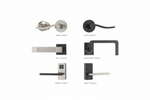
Door handle mechanisms fall into five main categories: lever latch (passage, no lock), lever privacy (thumb turn for bathrooms), lever keyed (entry with key cylinder), pull handle (no latch, pull only), and mortise lock (integrated bolt within the door edge). Each operates differently and suits specific doors, rooms, and security requirements.
Door handle style and door handle mechanism are two separate decisions, and confusing them is one of the most common hardware mistakes in a renovation project. This guide explains every common mechanism type, how each one works, and which is right for which door and room, so you choose hardware that performs the way your space actually needs.
How a Door Handle Mechanism Works: The Core Components
Before distinguishing between mechanism types, understanding the four components shared by nearly every door handle assembly makes the differences between types much clearer.
The spindle is the square metal rod that connects the handle on both sides of the door. When the handle is pressed down or turned, the spindle rotates and operates the internal latch or lock body. The latch bolt is the spring-loaded beveled component that snaps into the strike plate mounted in the door frame, keeping the door closed. In mechanisms with a locking function, the lock body contains additional components, such as a pin tumbler cylinder activated by a key or a thumb turn that manually slides a blocking element. The backplate or rose covers the fixing hardware at the face of the door. A backplate is the traditional rectangular or shaped escutcheon; a rose is the minimalist round surround common in contemporary hardware.

Together these four elements, the spindle, latch bolt, lock body, and mounting plate, form the mechanism system. What varies between mechanism types is primarily what the lock body does or does not do when the handle is operated.
The Main Types of Door Handle Mechanisms
Each mechanism type is designed for a specific level of function, from open passage to secure entry. Matching the mechanism to the door's purpose is more important than matching the visual style.
Lever Latch (Passage Mechanism)
The most common interior door mechanism in US residential construction. Pressing the lever down rotates the spindle, which retracts the spring latch bolt and allows the door to open. No locking function is included. The door can be operated from both sides without a key or any secondary action. Suitable for any door in common areas of a home where neither privacy nor security is a requirement, including hallways, pantries, utility rooms, and closets.
Privacy Mechanism (Thumb Turn or Button)
A button or thumb turn on the interior side engages a blocking element that prevents the latch from being retracted by the exterior handle. The exterior side cannot be locked from outside and cannot be unlocked with a standard key. An emergency override is provided on the exterior, typically a small pinhole that accepts a thin tool or a coin slot that turns a release tab. Designed specifically for situations where a person needs to lock a door from inside without requiring a key. Common for bathroom and bedroom applications.

Keyed Lever Mechanism
Integrates a key cylinder into the backplate or lever body. The exterior side requires a key to retract the latch or engage a deadlatch. The interior side typically provides a thumb turn or free-moving lever for egress without a key. Available in passage-keyed configurations, where only the latch is controlled, or deadlatching configurations that provide added resistance to credit-card attacks. Used wherever key-controlled access is required, including home offices, utility rooms, and all entry doors.
Knob Mechanism
Operates the same internal spindle and latch system as a lever but requires a gripping and twisting motion rather than a downward press. Available in the same configurations as levers: passage, privacy, and keyed. The practical limitation is that the twisting motion required to operate a knob creates difficulty for users with arthritis, limited grip strength, or young children. This is why knobs are not considered ADA-compliant for required accessible routes in commercial applications and are decreasing in new residential installations.
Pull Handle (No Latch Mechanism)
A fixed handle with no spindle connection and no latch function. The door is moved entirely by a push or pull directly against the handle, which serves only as a grip point. No mechanical latching occurs at the handle itself. A separate surface bolt, magnetic catch, or friction latch may hold the door when closed. Used on sliding glass doors, single and double barn doors, pocket doors, and commercial interior entrances where the door configuration does not allow a traditional latch strike plate to be installed in a fixed frame.
Mortise Lock Mechanism
The lock body is housed within a mortised pocket cut into the face of the door edge rather than on the door surface. Depending on configuration, a single turn of the handle can operate both the latch and the deadbolt simultaneously, or the deadbolt can be thrown independently by the key or thumb turn. Provides significantly more engagement contact and a more integrated appearance than surface-mounted tubular mechanisms. Standard in European-manufactured interior and entry doors and increasingly specified in high-end US residential projects where a full mortise pocket is pre-cut by the door manufacturer.
See more: What Is a Swing Door? Types of Swing Doors Explained

Types of Door Handle Locks: Locking Mechanisms Compared
The lock mechanism is the security layer that sits within or alongside the handle mechanism. The following types differ in how they engage, who controls them, and what security level they provide.
|
Lock Type |
How It Engages |
Controlled By |
Best For |
Security |
|---|---|---|---|---|
|
Tubular latch |
Spring bolt, beveled |
Handle press |
Interior passage doors |
None |
|
Privacy lock |
Button or thumb turn |
Inside only; emergency pin outside |
Bathrooms, bedrooms |
Low |
|
Keyed cylinder |
Pin tumbler by key |
Key + optional thumb turn |
Entry doors, offices |
Medium-High |
|
Deadbolt |
Solid bolt, no spring |
Key or inside thumb turn |
Front doors |
High |
|
Mortise lock |
Latch + bolt integrated |
Key + lever combo |
Entry, European interior doors |
High |
|
Multipoint lock |
3+ points across frame |
Single key turn |
European patio and entry doors |
Very High |
Tubular latch is not a security device. It holds the door closed but provides no resistance to forced entry. Deadbolt and mortise locks provide the highest security for single-point and integrated systems respectively. Multipoint locks engage the frame at three or more positions simultaneously and are standard on European-manufactured exterior door systems.
For European-style handles with integrated privacy and keyed mechanisms suited to modern interior doors, our European interior door hardware collection includes lever sets, magnetic locks, pocket locks, and privacy and key sets designed for mortise-compatible door systems.
US Standard vs European Door Handle Mechanisms
Most US homeowners have encountered only one handle system. Most European-manufactured interior doors require the other. Specifying the wrong system results in a door that cannot accept the hardware without additional boring or cutting, which adds cost and time to the project.
US Standard (Tubular) Mechanism
The lock body is housed in a cylindrical casing that inserts into a 2-1/8 inch diameter face borehole with a 1 inch diameter edge bore. This preparation is standard across virtually all US residential pre-hung doors and pre-bored slabs and is installed and serviced by any US residential contractor without specialized tools. The latch and lock are separate components, which allows them to be replaced individually. The system is widely stocked at hardware retailers nationally, and replacement hardware is straightforward to source.
European (Mortise) Mechanism
The lock body sits within a full mortise pocket running along the door edge, typically 13mm to 14mm wide and varying in height depending on the manufacturer. The handle spindle connects to the lock body rather than a separate latch casing, allowing a single handle motion to operate the latch, the deadbolt, or both simultaneously depending on the lock function. Requires a door that has been pre-mortised to the exact dimensions of the lock body. Different European manufacturers use different pocket dimensions, so mortise locks are not universally interchangeable without verifying compatibility.

|
Factor |
US Standard (Tubular) |
European (Mortise) |
|---|---|---|
|
Lock body location |
Cylindrical casing in face borehole |
Recessed into door edge mortise |
|
Latch and lock |
Separate components |
Integrated in one body |
|
Door preparation |
2-1/8" face bore + 1" edge bore |
Full mortise pocket in edge |
|
Contractor familiarity in US |
Universal |
Specialty installer recommended |
|
Parts availability in US |
Hardware retailers nationwide |
Specialty retailers |
|
Security level |
Medium (single latch or deadbolt) |
High (integrated multi-function body) |
The two systems are not interchangeable without door modification. Before purchasing, confirm whether the door is pre-bored for tubular or pre-mortised for a specific lock body. When both are options, the European mortise system delivers more function with less visible hardware.
The door preparation required for each mechanism type is directly connected to whether the door is purchased as a slab or a prehung unit. Our guide on door slab vs prehung explains how this decision affects which mechanism can be installed without additional boring or frame modification.
Choosing the Right Mechanism by Room and Application
No single mechanism is right for every door in a home. The correct choice follows from three questions: who uses this space, what level of privacy or security is needed, and what door configuration is being installed.
|
Room / Application |
Recommended Mechanism |
Lock Type |
Reason |
|---|---|---|---|
|
Hallway / corridor |
Lever latch (passage) |
None |
High traffic, no privacy needed |
|
Bedroom |
Lever privacy |
Thumb turn |
Privacy from inside, no key required |
|
Bathroom |
Lever privacy + emergency release |
Thumb turn with override |
Privacy plus safety exit override |
|
Home office |
Lever keyed or privacy |
Keyed cylinder or thumb turn |
Security or privacy depending on use |
|
Entry / front door |
Keyed lever + deadbolt |
Keyed + deadbolt |
Controlled access, highest security |
|
Closet |
Lever latch or pull handle |
None |
Simple operation, no security needed |
|
Pocket door |
Flush pull + pocket privacy lock |
None or pocket lock |
Flush hardware, no frame for latch plate |
|
Barn / sliding door |
Pull handle + surface bolt |
None or surface bolt |
No fixed frame for standard latch strike |
|
Interior French doors |
Lever privacy + flush bolt (passive leaf) |
Thumb turn + passive bolt |
Active and passive leaf coordination required |
Passage mechanism for all common-area interior doors. Privacy for bedrooms and bathrooms. Keyed for controlled access. Pull handles and pocket locks for sliding and pocket configurations where no fixed frame accepts a standard latch strike plate.
For a two-panel configuration such as interior French doors, the active leaf uses a standard lever privacy or keyed mechanism while the passive leaf requires a flush bolt or surface bolt to hold it securely in the frame. Hardware for both leaves must be specified together to ensure compatible finishes and operating logic.
See more: How to Install Interior French Doors: Step-by-Step Guide
Accessibility Considerations: Lever vs Knob for ADA Compliance
For homeowners designing accessible homes or commercial spaces subject to ADA requirements, the distinction between lever and knob mechanism is not a stylistic choice. It is a compliance requirement in many applications.
ADA Standards for Accessible Design require that operable hardware on accessible routes must be usable with one hand and without tight grasping, pinching, or twisting of the wrist. Lever handles comply with this standard. Round knobs require a gripping and rotating motion that fails the standard. For residential projects, ADA compliance is voluntary but increasingly recommended for aging-in-place design, as lever handles reduce strain for residents with arthritis, reduced grip strength, or limited hand mobility.
For commercial spaces including offices, retail premises, and multi-family building common areas, lever mechanisms are generally code-required on all doors along required accessible egress routes. The ADA requirement applies to the operating function, not the visual style, which means lever handles are available in every finish and aesthetic to match any interior design specification.
See more: What Is a Prehung Interior Door? Difference Between Prehung and Slab Door

Conclusion
The right door handle mechanism depends on function before aesthetics: passage for open spaces, privacy for bathrooms and bedrooms, keyed for controlled access, and mortise for European door systems that require integrated locking. Confirm the door preparation before ordering, verify whether US tubular or European mortise sizing is required, and specify levers rather than knobs on any door that needs to meet accessibility standards.
Types of Door Handle Mechanisms Explained: Latch, Lock, Privacy, Mortise and More

Door handle mechanisms fall into five main categories: lever latch (passage, no lock), lever privacy (thumb turn for bathrooms), lever keyed (entry with key cylinder), pull handle (no latch, pull only), and mortise lock (integrated bolt within the door edge). Each operates differently and suits specific doors, rooms, and security requirements.
Door handle style and door handle mechanism are two separate decisions, and confusing them is one of the most common hardware mistakes in a renovation project. This guide explains every common mechanism type, how each one works, and which is right for which door and room, so you choose hardware that performs the way your space actually needs.
How a Door Handle Mechanism Works: The Core Components
Before distinguishing between mechanism types, understanding the four components shared by nearly every door handle assembly makes the differences between types much clearer.
The spindle is the square metal rod that connects the handle on both sides of the door. When the handle is pressed down or turned, the spindle rotates and operates the internal latch or lock body. The latch bolt is the spring-loaded beveled component that snaps into the strike plate mounted in the door frame, keeping the door closed. In mechanisms with a locking function, the lock body contains additional components, such as a pin tumbler cylinder activated by a key or a thumb turn that manually slides a blocking element. The backplate or rose covers the fixing hardware at the face of the door. A backplate is the traditional rectangular or shaped escutcheon; a rose is the minimalist round surround common in contemporary hardware.
Together these four elements, the spindle, latch bolt, lock body, and mounting plate, form the mechanism system. What varies between mechanism types is primarily what the lock body does or does not do when the handle is operated.
The Main Types of Door Handle Mechanisms
Each mechanism type is designed for a specific level of function, from open passage to secure entry. Matching the mechanism to the door's purpose is more important than matching the visual style.
Lever Latch (Passage Mechanism)
The most common interior door mechanism in US residential construction. Pressing the lever down rotates the spindle, which retracts the spring latch bolt and allows the door to open. No locking function is included. The door can be operated from both sides without a key or any secondary action. Suitable for any door in common areas of a home where neither privacy nor security is a requirement, including hallways, pantries, utility rooms, and closets.
Privacy Mechanism (Thumb Turn or Button)
A button or thumb turn on the interior side engages a blocking element that prevents the latch from being retracted by the exterior handle. The exterior side cannot be locked from outside and cannot be unlocked with a standard key. An emergency override is provided on the exterior, typically a small pinhole that accepts a thin tool or a coin slot that turns a release tab. Designed specifically for situations where a person needs to lock a door from inside without requiring a key. Common for bathroom and bedroom applications.
Keyed Lever Mechanism
Integrates a key cylinder into the backplate or lever body. The exterior side requires a key to retract the latch or engage a deadlatch. The interior side typically provides a thumb turn or free-moving lever for egress without a key. Available in passage-keyed configurations, where only the latch is controlled, or deadlatching configurations that provide added resistance to credit-card attacks. Used wherever key-controlled access is required, including home offices, utility rooms, and all entry doors.
Knob Mechanism
Operates the same internal spindle and latch system as a lever but requires a gripping and twisting motion rather than a downward press. Available in the same configurations as levers: passage, privacy, and keyed. The practical limitation is that the twisting motion required to operate a knob creates difficulty for users with arthritis, limited grip strength, or young children. This is why knobs are not considered ADA-compliant for required accessible routes in commercial applications and are decreasing in new residential installations.
Pull Handle (No Latch Mechanism)
A fixed handle with no spindle connection and no latch function. The door is moved entirely by a push or pull directly against the handle, which serves only as a grip point. No mechanical latching occurs at the handle itself. A separate surface bolt, magnetic catch, or friction latch may hold the door when closed. Used on sliding glass doors, single and double barn doors, pocket doors, and commercial interior entrances where the door configuration does not allow a traditional latch strike plate to be installed in a fixed frame.
Mortise Lock Mechanism
The lock body is housed within a mortised pocket cut into the face of the door edge rather than on the door surface. Depending on configuration, a single turn of the handle can operate both the latch and the deadbolt simultaneously, or the deadbolt can be thrown independently by the key or thumb turn. Provides significantly more engagement contact and a more integrated appearance than surface-mounted tubular mechanisms. Standard in European-manufactured interior and entry doors and increasingly specified in high-end US residential projects where a full mortise pocket is pre-cut by the door manufacturer.
See more: What Is a Swing Door? Types of Swing Doors Explained
Types of Door Handle Locks: Locking Mechanisms Compared
The lock mechanism is the security layer that sits within or alongside the handle mechanism. The following types differ in how they engage, who controls them, and what security level they provide.
|
Lock Type |
How It Engages |
Controlled By |
Best For |
Security |
|---|---|---|---|---|
|
Tubular latch |
Spring bolt, beveled |
Handle press |
Interior passage doors |
None |
|
Privacy lock |
Button or thumb turn |
Inside only; emergency pin outside |
Bathrooms, bedrooms |
Low |
|
Keyed cylinder |
Pin tumbler by key |
Key + optional thumb turn |
Entry doors, offices |
Medium-High |
|
Deadbolt |
Solid bolt, no spring |
Key or inside thumb turn |
Front doors |
High |
|
Mortise lock |
Latch + bolt integrated |
Key + lever combo |
Entry, European interior doors |
High |
|
Multipoint lock |
3+ points across frame |
Single key turn |
European patio and entry doors |
Very High |
Tubular latch is not a security device. It holds the door closed but provides no resistance to forced entry. Deadbolt and mortise locks provide the highest security for single-point and integrated systems respectively. Multipoint locks engage the frame at three or more positions simultaneously and are standard on European-manufactured exterior door systems.
For European-style handles with integrated privacy and keyed mechanisms suited to modern interior doors, our European interior door hardware collection includes lever sets, magnetic locks, pocket locks, and privacy and key sets designed for mortise-compatible door systems.
US Standard vs European Door Handle Mechanisms
Most US homeowners have encountered only one handle system. Most European-manufactured interior doors require the other. Specifying the wrong system results in a door that cannot accept the hardware without additional boring or cutting, which adds cost and time to the project.
US Standard (Tubular) Mechanism
The lock body is housed in a cylindrical casing that inserts into a 2-1/8 inch diameter face borehole with a 1 inch diameter edge bore. This preparation is standard across virtually all US residential pre-hung doors and pre-bored slabs and is installed and serviced by any US residential contractor without specialized tools. The latch and lock are separate components, which allows them to be replaced individually. The system is widely stocked at hardware retailers nationally, and replacement hardware is straightforward to source.
European (Mortise) Mechanism
The lock body sits within a full mortise pocket running along the door edge, typically 13mm to 14mm wide and varying in height depending on the manufacturer. The handle spindle connects to the lock body rather than a separate latch casing, allowing a single handle motion to operate the latch, the deadbolt, or both simultaneously depending on the lock function. Requires a door that has been pre-mortised to the exact dimensions of the lock body. Different European manufacturers use different pocket dimensions, so mortise locks are not universally interchangeable without verifying compatibility.
|
Factor |
US Standard (Tubular) |
European (Mortise) |
|---|---|---|
|
Lock body location |
Cylindrical casing in face borehole |
Recessed into door edge mortise |
|
Latch and lock |
Separate components |
Integrated in one body |
|
Door preparation |
2-1/8" face bore + 1" edge bore |
Full mortise pocket in edge |
|
Contractor familiarity in US |
Universal |
Specialty installer recommended |
|
Parts availability in US |
Hardware retailers nationwide |
Specialty retailers |
|
Security level |
Medium (single latch or deadbolt) |
High (integrated multi-function body) |
The two systems are not interchangeable without door modification. Before purchasing, confirm whether the door is pre-bored for tubular or pre-mortised for a specific lock body. When both are options, the European mortise system delivers more function with less visible hardware.
The door preparation required for each mechanism type is directly connected to whether the door is purchased as a slab or a prehung unit. Our guide on door slab vs prehung explains how this decision affects which mechanism can be installed without additional boring or frame modification.
Choosing the Right Mechanism by Room and Application
No single mechanism is right for every door in a home. The correct choice follows from three questions: who uses this space, what level of privacy or security is needed, and what door configuration is being installed.
|
Room / Application |
Recommended Mechanism |
Lock Type |
Reason |
|---|---|---|---|
|
Hallway / corridor |
Lever latch (passage) |
None |
High traffic, no privacy needed |
|
Bedroom |
Lever privacy |
Thumb turn |
Privacy from inside, no key required |
|
Bathroom |
Lever privacy + emergency release |
Thumb turn with override |
Privacy plus safety exit override |
|
Home office |
Lever keyed or privacy |
Keyed cylinder or thumb turn |
Security or privacy depending on use |
|
Entry / front door |
Keyed lever + deadbolt |
Keyed + deadbolt |
Controlled access, highest security |
|
Closet |
Lever latch or pull handle |
None |
Simple operation, no security needed |
|
Pocket door |
Flush pull + pocket privacy lock |
None or pocket lock |
Flush hardware, no frame for latch plate |
|
Barn / sliding door |
Pull handle + surface bolt |
None or surface bolt |
No fixed frame for standard latch strike |
|
Interior French doors |
Lever privacy + flush bolt (passive leaf) |
Thumb turn + passive bolt |
Active and passive leaf coordination required |
Passage mechanism for all common-area interior doors. Privacy for bedrooms and bathrooms. Keyed for controlled access. Pull handles and pocket locks for sliding and pocket configurations where no fixed frame accepts a standard latch strike plate.
For a two-panel configuration such as interior French doors, the active leaf uses a standard lever privacy or keyed mechanism while the passive leaf requires a flush bolt or surface bolt to hold it securely in the frame. Hardware for both leaves must be specified together to ensure compatible finishes and operating logic.
See more: How to Install Interior French Doors: Step-by-Step Guide
Accessibility Considerations: Lever vs Knob for ADA Compliance
For homeowners designing accessible homes or commercial spaces subject to ADA requirements, the distinction between lever and knob mechanism is not a stylistic choice. It is a compliance requirement in many applications.
ADA Standards for Accessible Design require that operable hardware on accessible routes must be usable with one hand and without tight grasping, pinching, or twisting of the wrist. Lever handles comply with this standard. Round knobs require a gripping and rotating motion that fails the standard. For residential projects, ADA compliance is voluntary but increasingly recommended for aging-in-place design, as lever handles reduce strain for residents with arthritis, reduced grip strength, or limited hand mobility.
For commercial spaces including offices, retail premises, and multi-family building common areas, lever mechanisms are generally code-required on all doors along required accessible egress routes. The ADA requirement applies to the operating function, not the visual style, which means lever handles are available in every finish and aesthetic to match any interior design specification.
See more: What Is a Prehung Interior Door? Difference Between Prehung and Slab Door
Conclusion
The right door handle mechanism depends on function before aesthetics: passage for open spaces, privacy for bathrooms and bedrooms, keyed for controlled access, and mortise for European door systems that require integrated locking. Confirm the door preparation before ordering, verify whether US tubular or European mortise sizing is required, and specify levers rather than knobs on any door that needs to meet accessibility standards.


