


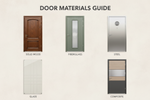
Interior doors are available in more material options than most homeowners realize, and the choice between them affects everything from how well a room holds sound to how much maintenance the door requires over time. This guide covers every main type of door material for interior applications, how each one is constructed, and which rooms each material suits best.
Interior doors are made from solid wood, MDF (medium density fiberboard), hollow core engineered wood, solid core engineered wood, or glass. Solid wood and MDF provide the best sound insulation and durability for bedrooms and offices. Hollow core is the most affordable and lightest option for closets and secondary spaces. Solid core offers the best balance between performance and cost. Glass panels are used for light transmission between rooms.
Understanding Door Construction: Face Material and Core
Most interior doors are not made from a single material throughout. They consist of a face, which is the visible surface on both sides of the panel, and a core, which is the internal structure between the two faces. Understanding this distinction explains why two doors that look identical on the outside can perform very differently in terms of sound, weight, and long-term durability.

The Face Material
The face is the visible surface of the door and determines its appearance and how well it accepts paint or stain. Face materials include thin hardwood veneer for doors intended to be stained, showing the natural wood grain; smooth MDF for doors intended to be painted, producing a flat and even surface; and molded composite skins that simulate panel door profiles at a lower cost than carved solid wood. The face material is a style and finish decision, not a performance decision.
The Core
The core is the internal structure that determines the door's weight, acoustic performance, and structural feel. The three main core types are hollow, using a cardboard honeycomb that produces the lightest and least expensive door; solid core, using compressed wood fiber or particleboard that produces a heavier door with better sound attenuation; and solid wood, using continuous natural lumber throughout. A door's performance is almost entirely determined by its core, not its face.
See more: Types of Interior Doors: Every Style, How They Work, and Which Room They Suit
The Main Types of Interior Door Material
Five door material types cover the full range of interior options available to US homeowners. Each has distinct performance characteristics that determine where it works best.
Solid Wood
Solid wood interior doors are constructed from natural lumber throughout, with no engineered core or filler material. Common species for painted applications include pine and poplar, which accept paint cleanly and are the more affordable options within the solid wood category. For stained applications where the natural grain is the design intent, oak, maple, walnut, and cherry are the most widely available species.
Solid wood doors have the most natural feel when opening and closing, the highest resistance to impact and denting, and the best acoustic performance of any wood-based door type. The main consideration is sensitivity to humidity: solid wood can expand, contract, or warp if the home has significant seasonal humidity swings without climate control.
Solid wood is the standard material for premium interior doors and for exterior entry doors where durability and appearance are the primary requirements.
See more: Types of Flush Doors: Hollow Core, Solid Core, and Surface Finishes Explained
MDF (Medium Density Fiberboard)
MDF is an engineered wood product made from compressed wood fiber and resin, producing a perfectly smooth, grain-free surface that accepts paint evenly and without the grain texture that shows through on natural wood. MDF interior doors do not warp because the material is dimensionally stable across a wide humidity range, making them a reliable choice in climates with seasonal moisture variation. Sound transmission class (STC) ratings for MDF doors typically fall between 32 and 35, making them effective for bedrooms and home offices where sound separation matters.
MDF is the standard face material for contemporary and minimalist interior door designs. White doors and other painted finishes are most commonly built on an MDF face because the smooth surface produces the cleanest, most consistent painted result of any door material.

Hollow Core
Flush doors in hollow core construction have a wood or composite face over a lightweight cardboard honeycomb interior. They are the lightest and least expensive of all interior door material types, with STC ratings typically as low as 15 to 20, meaning they provide minimal resistance to sound transmission. Hollow core is appropriate for closets, pantries, laundry rooms, and other secondary spaces where sound insulation is not a requirement. Their light weight makes them easy to hang and straightforward to replace when updating multiple doors across a home.
Solid Core
Solid flush doors replace the cardboard honeycomb with a compressed wood fiber or particleboard fill, giving them a weight and feel close to solid wood at a significantly lower cost. STC ratings for solid core doors range from approximately 25 to 30, better than hollow core but generally below solid wood or full MDF construction. Solid core is the most practical upgrade from hollow core for homeowners who want meaningful sound separation in bedrooms and home offices without the cost of solid wood. They require heavier-duty hinges due to their greater weight.
Glass
Glass is used in interior doors either as full-panel glazing for maximum light transmission or as partial inserts within a wood or MDF frame. Frosted or obscured glass maintains privacy while still allowing light to pass between rooms, making it suitable for bathrooms and home offices adjacent to corridors.
Clear glass suits common areas where visual connection between rooms is desirable. Glass doors are available with frosted glass for privacy or clear panels for open visual flow, and pair naturally with French door configurations between living and dining spaces. Glass inserts provide no meaningful sound insulation and should not be specified where acoustic separation is a primary requirement.
See more: Pros and Cons of French Doors: An Honest Assessment for Homeowners Considering the Investment

Door Material Comparison at a Glance
The table below compares the five main interior door material types across the criteria that most affect residential renovation decisions, including STC sound ratings, weight, relative cost, moisture resistance, and best room applications.
|
Material |
STC Range |
Weight |
Cost Tier |
Moisture Resistance |
Best Rooms |
|
Solid wood |
30 to 35 |
Heavy |
High |
Moderate , can warp with humidity |
Bedroom, office, formal areas |
|
MDF |
32 to 35 |
Medium-heavy |
Medium |
Good , dimensionally stable |
Bedroom, office, hallway |
|
Hollow core |
15 to 20 |
Light |
Low |
Fair |
Closet, pantry, laundry room |
|
Solid core |
25 to 30 |
Medium-heavy |
Medium |
Good |
Bedroom, bathroom, office |
|
Glass panel |
Minimal |
Varies |
Medium-high |
Good (tempered glass) |
Living areas, dining room, pantry |
STC (Sound Transmission Class) measures how much sound a door blocks , higher is better. Hollow core doors at STC 15 to 20 allow most sound through. Solid core and MDF at STC 25 to 35 provide meaningful noise reduction for bedrooms and offices. Solid wood at STC 30 to 35 delivers the best acoustic performance of any wood-based door type. Always verify specific STC ratings with the product manufacturer before specifying for acoustic-sensitive rooms.
Browse interior door options at Doors and Beyond in solid flush, glass, and panel configurations: Browse Modern Doors at Doors and Beyond
Which Door Material Is Right for Each Room?
The right door material type for any room depends on three factors: how much sound separation the room needs, what the moisture exposure level is, and what the aesthetic goal is. The table below maps common rooms to the material that best fits each situation.
|
Room |
Recommended Material |
Key Reason |
|
Bedroom |
Solid core or MDF |
Sound separation from living areas; solid core is cost-effective upgrade from hollow core |
|
Master bathroom |
Solid core or MDF |
Privacy; both materials are moisture-stable in normal interior humidity conditions |
|
Home office |
Solid core or MDF |
Acoustic separation for focus; used frequently so durability matters |
|
Living room to dining room |
Glass panel in wood/MDF frame |
Light flow and visual connection between spaces without blocking openness |
|
Bedroom closet |
Hollow core |
No acoustic requirement; lightweight simplifies installation and operation |
|
Pantry |
Hollow core or glass panel |
No privacy need; glass adds visual character in open-plan kitchens |
|
Laundry room |
Hollow core or solid core |
Hollow for budget priority; solid core if appliance noise is a concern |
|
Home gym or media room |
Solid wood or MDF |
Maximum sound containment; solid wood or dense MDF provide the highest STC values |
For rooms where privacy and quiet matter most, solid core or MDF are the practical choice at a reasonable cost. Hollow core is the right default for any secondary space where sound is not a concern. Glass is the strongest choice wherever light connection between rooms is a design priority.
How to Choose the Right Door Material for Your Project
Once the room requirements are clear, three additional factors help narrow the final material choice: budget, maintenance preference, and home interior style.

Budget
Hollow core is the entry point across all interior door material types. Solid core and MDF sit in the mid-range, with similar pricing in most US markets. Solid wood is the premium option. The cost difference between hollow and solid core is relatively small per door but adds up across a whole-home renovation with eight to twelve doors. For projects where budget is a constraint, specifying solid core only in bedrooms, bathrooms, and home offices, with hollow core in closets and utility spaces, produces the best performance-to-cost balance.
Maintenance
MDF requires repainting when chips or scuffs accumulate, which is straightforward but does need periodic attention. Solid wood can be sanded and refinished, extending its life significantly but requiring more effort. Hollow and solid core doors with MDF or composite faces share the same maintenance profile as MDF: paint-ready and repaint-when-needed. Glass panels require cleaning but no structural maintenance. Door material choice and finish maintenance are closely linked, and the painting technique used on interior doors affects how long the finish stays clean and even.
See more: Interior Door Colors and Paint Ideas
Home Interior Style
Home style affects the face material and finish more than the core. Contemporary and minimalist interiors suit smooth MDF faces with painted finishes. Traditional and transitional interiors suit wood veneer faces or molded composite panel designs that replicate the look of solid wood panel doors. The core choice is independent of the style decision: a contemporary flush door can have a solid core, and a traditional panel door can have a hollow core. Matching the face finish to existing trim, flooring, and hardware finishes in the room produces the most cohesive result regardless of which core is specified.
Final Thoughts
Understanding the types of door material available for interior applications makes every renovation decision more straightforward. The face material determines how the door looks and how it is finished. The core material determines how it performs acoustically and structurally. Choosing the right combination for each room, rather than applying the same material throughout, produces the best result for both performance and budget.
Browse interior door collections at Doors and Beyond, including flush, glass, panel, and French door styles: Browse Interior Doors at Doors and Beyond
Types of Door Material: What Interior Doors Are Made Of and Which to Choose for Each Room

Interior doors are available in more material options than most homeowners realize, and the choice between them affects everything from how well a room holds sound to how much maintenance the door requires over time. This guide covers every main type of door material for interior applications, how each one is constructed, and which rooms each material suits best.
Interior doors are made from solid wood, MDF (medium density fiberboard), hollow core engineered wood, solid core engineered wood, or glass. Solid wood and MDF provide the best sound insulation and durability for bedrooms and offices. Hollow core is the most affordable and lightest option for closets and secondary spaces. Solid core offers the best balance between performance and cost. Glass panels are used for light transmission between rooms.
Understanding Door Construction: Face Material and Core
Most interior doors are not made from a single material throughout. They consist of a face, which is the visible surface on both sides of the panel, and a core, which is the internal structure between the two faces. Understanding this distinction explains why two doors that look identical on the outside can perform very differently in terms of sound, weight, and long-term durability.
The Face Material
The face is the visible surface of the door and determines its appearance and how well it accepts paint or stain. Face materials include thin hardwood veneer for doors intended to be stained, showing the natural wood grain; smooth MDF for doors intended to be painted, producing a flat and even surface; and molded composite skins that simulate panel door profiles at a lower cost than carved solid wood. The face material is a style and finish decision, not a performance decision.
The Core
The core is the internal structure that determines the door's weight, acoustic performance, and structural feel. The three main core types are hollow, using a cardboard honeycomb that produces the lightest and least expensive door; solid core, using compressed wood fiber or particleboard that produces a heavier door with better sound attenuation; and solid wood, using continuous natural lumber throughout. A door's performance is almost entirely determined by its core, not its face.
See more: Types of Interior Doors: Every Style, How They Work, and Which Room They Suit
The Main Types of Interior Door Material
Five door material types cover the full range of interior options available to US homeowners. Each has distinct performance characteristics that determine where it works best.
Solid Wood
Solid wood interior doors are constructed from natural lumber throughout, with no engineered core or filler material. Common species for painted applications include pine and poplar, which accept paint cleanly and are the more affordable options within the solid wood category. For stained applications where the natural grain is the design intent, oak, maple, walnut, and cherry are the most widely available species.
Solid wood doors have the most natural feel when opening and closing, the highest resistance to impact and denting, and the best acoustic performance of any wood-based door type. The main consideration is sensitivity to humidity: solid wood can expand, contract, or warp if the home has significant seasonal humidity swings without climate control.
Solid wood is the standard material for premium interior doors and for exterior entry doors where durability and appearance are the primary requirements.
See more: Types of Flush Doors: Hollow Core, Solid Core, and Surface Finishes Explained
MDF (Medium Density Fiberboard)
MDF is an engineered wood product made from compressed wood fiber and resin, producing a perfectly smooth, grain-free surface that accepts paint evenly and without the grain texture that shows through on natural wood. MDF interior doors do not warp because the material is dimensionally stable across a wide humidity range, making them a reliable choice in climates with seasonal moisture variation. Sound transmission class (STC) ratings for MDF doors typically fall between 32 and 35, making them effective for bedrooms and home offices where sound separation matters.
MDF is the standard face material for contemporary and minimalist interior door designs. White doors and other painted finishes are most commonly built on an MDF face because the smooth surface produces the cleanest, most consistent painted result of any door material.
Hollow Core
Flush doors in hollow core construction have a wood or composite face over a lightweight cardboard honeycomb interior. They are the lightest and least expensive of all interior door material types, with STC ratings typically as low as 15 to 20, meaning they provide minimal resistance to sound transmission. Hollow core is appropriate for closets, pantries, laundry rooms, and other secondary spaces where sound insulation is not a requirement. Their light weight makes them easy to hang and straightforward to replace when updating multiple doors across a home.
Solid Core
Solid flush doors replace the cardboard honeycomb with a compressed wood fiber or particleboard fill, giving them a weight and feel close to solid wood at a significantly lower cost. STC ratings for solid core doors range from approximately 25 to 30, better than hollow core but generally below solid wood or full MDF construction. Solid core is the most practical upgrade from hollow core for homeowners who want meaningful sound separation in bedrooms and home offices without the cost of solid wood. They require heavier-duty hinges due to their greater weight.
Glass
Glass is used in interior doors either as full-panel glazing for maximum light transmission or as partial inserts within a wood or MDF frame. Frosted or obscured glass maintains privacy while still allowing light to pass between rooms, making it suitable for bathrooms and home offices adjacent to corridors.
Clear glass suits common areas where visual connection between rooms is desirable. Glass doors are available with frosted glass for privacy or clear panels for open visual flow, and pair naturally with French door configurations between living and dining spaces. Glass inserts provide no meaningful sound insulation and should not be specified where acoustic separation is a primary requirement.
See more: Pros and Cons of French Doors: An Honest Assessment for Homeowners Considering the Investment
Door Material Comparison at a Glance
The table below compares the five main interior door material types across the criteria that most affect residential renovation decisions, including STC sound ratings, weight, relative cost, moisture resistance, and best room applications.
|
Material |
STC Range |
Weight |
Cost Tier |
Moisture Resistance |
Best Rooms |
|
Solid wood |
30 to 35 |
Heavy |
High |
Moderate , can warp with humidity |
Bedroom, office, formal areas |
|
MDF |
32 to 35 |
Medium-heavy |
Medium |
Good , dimensionally stable |
Bedroom, office, hallway |
|
Hollow core |
15 to 20 |
Light |
Low |
Fair |
Closet, pantry, laundry room |
|
Solid core |
25 to 30 |
Medium-heavy |
Medium |
Good |
Bedroom, bathroom, office |
|
Glass panel |
Minimal |
Varies |
Medium-high |
Good (tempered glass) |
Living areas, dining room, pantry |
STC (Sound Transmission Class) measures how much sound a door blocks , higher is better. Hollow core doors at STC 15 to 20 allow most sound through. Solid core and MDF at STC 25 to 35 provide meaningful noise reduction for bedrooms and offices. Solid wood at STC 30 to 35 delivers the best acoustic performance of any wood-based door type. Always verify specific STC ratings with the product manufacturer before specifying for acoustic-sensitive rooms.
Browse interior door options at Doors and Beyond in solid flush, glass, and panel configurations: Browse Modern Doors at Doors and Beyond
Which Door Material Is Right for Each Room?
The right door material type for any room depends on three factors: how much sound separation the room needs, what the moisture exposure level is, and what the aesthetic goal is. The table below maps common rooms to the material that best fits each situation.
|
Room |
Recommended Material |
Key Reason |
|
Bedroom |
Solid core or MDF |
Sound separation from living areas; solid core is cost-effective upgrade from hollow core |
|
Master bathroom |
Solid core or MDF |
Privacy; both materials are moisture-stable in normal interior humidity conditions |
|
Home office |
Solid core or MDF |
Acoustic separation for focus; used frequently so durability matters |
|
Living room to dining room |
Glass panel in wood/MDF frame |
Light flow and visual connection between spaces without blocking openness |
|
Bedroom closet |
Hollow core |
No acoustic requirement; lightweight simplifies installation and operation |
|
Pantry |
Hollow core or glass panel |
No privacy need; glass adds visual character in open-plan kitchens |
|
Laundry room |
Hollow core or solid core |
Hollow for budget priority; solid core if appliance noise is a concern |
|
Home gym or media room |
Solid wood or MDF |
Maximum sound containment; solid wood or dense MDF provide the highest STC values |
For rooms where privacy and quiet matter most, solid core or MDF are the practical choice at a reasonable cost. Hollow core is the right default for any secondary space where sound is not a concern. Glass is the strongest choice wherever light connection between rooms is a design priority.
How to Choose the Right Door Material for Your Project
Once the room requirements are clear, three additional factors help narrow the final material choice: budget, maintenance preference, and home interior style.
Budget
Hollow core is the entry point across all interior door material types. Solid core and MDF sit in the mid-range, with similar pricing in most US markets. Solid wood is the premium option. The cost difference between hollow and solid core is relatively small per door but adds up across a whole-home renovation with eight to twelve doors. For projects where budget is a constraint, specifying solid core only in bedrooms, bathrooms, and home offices, with hollow core in closets and utility spaces, produces the best performance-to-cost balance.
Maintenance
MDF requires repainting when chips or scuffs accumulate, which is straightforward but does need periodic attention. Solid wood can be sanded and refinished, extending its life significantly but requiring more effort. Hollow and solid core doors with MDF or composite faces share the same maintenance profile as MDF: paint-ready and repaint-when-needed. Glass panels require cleaning but no structural maintenance. Door material choice and finish maintenance are closely linked, and the painting technique used on interior doors affects how long the finish stays clean and even.
See more: Interior Door Colors and Paint Ideas
Home Interior Style
Home style affects the face material and finish more than the core. Contemporary and minimalist interiors suit smooth MDF faces with painted finishes. Traditional and transitional interiors suit wood veneer faces or molded composite panel designs that replicate the look of solid wood panel doors. The core choice is independent of the style decision: a contemporary flush door can have a solid core, and a traditional panel door can have a hollow core. Matching the face finish to existing trim, flooring, and hardware finishes in the room produces the most cohesive result regardless of which core is specified.
Final Thoughts
Understanding the types of door material available for interior applications makes every renovation decision more straightforward. The face material determines how the door looks and how it is finished. The core material determines how it performs acoustically and structurally. Choosing the right combination for each room, rather than applying the same material throughout, produces the best result for both performance and budget.
Browse interior door collections at Doors and Beyond, including flush, glass, panel, and French door styles: Browse Interior Doors at Doors and Beyond
Recent Post
Types of Door Material: What Interior Doors Are Made Of and Which to Choose for Each Room
Read More
The Best Way to Paint Interior Doors: Tools, Prep, and Technique for a Pro Finish
Read More
