


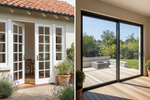
The phrase patio doors causes more confusion than almost any other term in home improvement. In US usage, French doors are technically a type of patio door, which means the question most homeowners are actually asking is: what is the difference between hinged French doors and sliding patio doors? This guide answers that directly and explains which option fits which home, space, and budget.
In US home improvement, patio door is an umbrella term that includes both French doors and sliding glass doors. The practical difference is how they open: French doors are hinged and swing in or out, while sliding patio doors glide on a track. French doors offer a wider opening and traditional aesthetics; sliding doors save floor space and provide unobstructed views.
First, a Terminology Clarification
Before comparing the two types, it helps to understand why the question itself is slightly misleading and what US homeowners are actually asking when they search for the difference between French doors and patio doors.
In the US, the term patio door originally referred to one specific product: the sliding glass door on a metal track that became standard in American homes during the 1960s and 70s. Over time, the term expanded to mean any door that provides access to a patio, deck, or backyard. Today, French doors, sliding glass doors, folding bi-fold doors, and multi-slide systems are all sold and marketed under the patio door category. When most US homeowners ask about the difference between French doors and patio doors, they are really asking: what is the difference between hinged French doors and the traditional sliding glass door? That is the comparison this guide addresses.

How They Open: The Fundamental Difference
The single most practical difference between French doors and sliding patio doors is the operating mechanism. This difference drives almost every other factor: space requirements, ventilation, opening width, and installation complexity.
French Doors: Hinged and Swinging
French doors are hinged at the sides of the frame and swing either inward into the room or outward onto the patio. A standard double French door pair creates a full-width opening of 60 to 72 inches or more when both panels are open. This wide, unobstructed opening is the primary practical advantage of French doors over sliding doors and makes them ideal for high-traffic spaces or situations where large items need to pass through regularly. The swing arc requires floor clearance of 24 to 36 inches on whichever side the doors open, and that clearance requirement is the main planning constraint to account for before installation.
Sliding Patio Doors: Track-Based, No Swing Arc
Sliding patio doors consist of two large glass panels in a frame, one fixed and one that slides horizontally along a track. The sliding panel travels in front of or behind the fixed panel to open. Because there is no swing arc, sliding doors work well in spaces where interior or exterior clearance is limited. The trade-off is that only approximately half the door width is accessible as a usable opening at any time. A 72-inch sliding door provides roughly 36 inches of actual passage width, compared to the full 72 inches available when both panels of a French door are open.
Side-by-Side Comparison
The table below compares French doors and sliding patio doors across the six factors that matter most to homeowners making a door selection decision.
|
Factor |
French Doors (Hinged) |
Sliding Patio Doors |
|
How they open |
Hinged; swing in or out from center |
Slide on horizontal track |
|
Usable opening width |
Full width when both panels open (60-72+ in.) |
Approx. 50% of total door width |
|
Space requirement |
Swing arc clearance needed (24-36 in.) |
No swing arc; track space beside door |
|
Aesthetics |
Traditional, formal, farmhouse |
Contemporary, minimalist, modern |
|
Energy efficiency |
Good; two-panel seal at center astragal |
Generally tighter factory seal; less center gap risk |
|
Security |
Multi-point locks standard; center seam is key |
Single lock standard; track reinforcement recommended |
|
Best for |
Traditional homes, wide openings, high traffic |
Contemporary homes, small patios, unobstructed views |
French doors consistently offer a wider usable opening and stronger traditional aesthetics at a higher price point and with greater space requirements. Sliding patio doors offer lower cost, no swing arc, and a more contemporary visual profile, at the cost of a narrower usable opening. The right choice depends on which of these trade-offs matters more for the specific space.
See more: Are French Doors More Secure Than Sliding Doors? A Full Comparison
Aesthetics: Traditional vs Contemporary
Beyond how they open, the visual difference between French doors and sliding patio doors is the most common deciding factor for homeowners who have adequate space for either type.
French Door Aesthetics
French doors are defined by their wider frame profiles, symmetrical double-panel design, and glass panels that span most of the door height. The thicker frames give them architectural weight and visual presence that reads as intentional and formal. They suit traditional, transitional, farmhouse, and colonial home styles naturally. Contemporary slim-frame versions in matte black aluminum have become popular in the past decade and extend the French door aesthetic to more modern homes, but even these versions carry a more pronounced visual profile than a standard sliding door.
Sliding Door Aesthetics
Sliding patio doors are defined by their large uninterrupted glass panels and narrow frame profiles. The slim sightlines maximize the glass area and create a near-seamless visual connection between interior and exterior. This is specifically about making the wall feel like it opens rather than having a door in it, an effect that French doors cannot replicate. Sliding doors suit contemporary, midcentury modern, and minimalist home styles. For homeowners whose primary goal is maximum light and an unobstructed view of the outdoor space, sliding doors are consistently the stronger choice.

Space Planning: The Practical Decision Factor
For many homeowners, aesthetic preferences are clear but available space makes the final decision. Both door types have specific clearance requirements that need to be confirmed before ordering.
When French Doors Work
French doors require a clear swing arc of 24 to 36 inches on the opening side of the door. Outswing French doors move the arc outside, which solves interior clearance problems but requires unobstructed exterior space directly in front of the door, which matters on small decks, covered porches with railings, or patios with furniture placed close to the house. Inswing doors keep the arc inside the room but restrict furniture placement near the entry. For rooms with adequate depth or patios with enough exterior clearance, neither constraint is significant. Standard French door pairs fit rough openings from 60 to 72 inches wide, with custom widths available beyond that.
When Sliding Doors Work Better
Sliding patio doors work in spaces where swing clearance is not available on either side of the threshold. Small interior rooms, narrow exterior landings, and covered porches where an outswing door would contact a railing or column all favor sliding doors. The track requires clean floor contact across the full door width, and the wall beside the door needs enough space for the sliding panel to park when open, typically equal to the width of one panel. Aside from those requirements, sliding doors have no directional clearance constraint.
See more: Should French Doors Open In or Out? Complete Installation Guide
Comparing door options for your home? Browse French doors and patio door options at Doors and Beyond: Browse French Doors at Doors and Beyond
Cost and Value
French doors generally cost more than sliding patio doors, and the gap is consistent enough to be a real factor for most homeowners.
A standard sliding glass patio door with professional installation costs approximately $800 to $3,000 depending on size and glass options. French doors with installation run $1,500 to $5,000 or more for the same size opening, with the higher cost driven by more complex frame construction, hardware, and the additional sealing work at the center astragal. Premium fiberglass or steel French doors with multi-point locking hardware sit at the top of that range. For homeowners with tight budgets, sliding doors deliver more door per dollar. For those investing in a long-term renovation where aesthetics and opening width matter, French doors typically offer a stronger return on resale value in traditional and transitional home markets, where the French door aesthetic is more directly associated with home quality.
See more: How Much Does a French Door Cost? Tips to Save Your Money
The Third Option Most Homeowners Miss
For homeowners who want the aesthetics of French doors but cannot accommodate the swing arc, one option bridges both categories and is worth knowing about before making a final decision.
The sliding French patio door combines the visual profile of a French door, wider frame, divided light or bold glass pattern, traditional hardware, with a sliding operating mechanism. Instead of swinging open, the panels travel along a track like a standard sliding door. This option resolves swing arc constraints entirely while preserving the French door aesthetic. It is available from several US manufacturers in two, three, and four-panel configurations spanning up to 16 feet wide. It costs slightly more than a standard sliding door but generally less than a hinged French door pair, and it is the right choice for homeowners who want French aesthetics but find that their space does not support the swing.
See more: How to Replace a Sliding Glass Door with French Doors: Cost, Steps and What to Know

Decision Guide: Which One Fits Your Situation
After reviewing all factors, most homeowners fall clearly into one category. The table below maps common situations to the door type that fits best.
|
Your Situation |
Best Choice |
Why |
|
Traditional or farmhouse home style |
French doors |
Aesthetics match; wide opening suits formal entertaining |
|
Contemporary or minimalist home |
Sliding patio doors |
Slim sightlines; unobstructed glass area |
|
Limited interior clearance near the door |
Sliding doors or outswing French doors |
No interior swing arc required |
|
Small exterior patio or narrow deck |
Sliding doors |
No exterior swing clearance needed |
|
High foot traffic between house and yard |
French doors |
Full-width opening; no passage restriction |
|
Budget under $2,000 installed |
Sliding doors |
Consistently lower cost at standard sizes |
|
Want French aesthetics, no room to swing |
Sliding French doors |
Hybrid: French profile with space-saving operation |
|
Moving large items in and out regularly |
French doors |
Full-width opening when both panels are open |
The decision almost always comes down to two variables: home style and available clearance. Homeowners with traditional homes and adequate space consistently prefer French doors. Homeowners in contemporary spaces or those with clearance constraints consistently prefer sliding doors. The sliding French door exists specifically for the overlap case where style preference and space constraints pull in opposite directions.
Final Thoughts
French doors and sliding patio doors are both excellent options, and the right choice depends entirely on the home's style, the available clearance, and the opening width needed. For traditional homes with enough room, French doors deliver aesthetics and wide access that sliding doors cannot match. For contemporary homes or tight spaces, sliding doors offer cleaner lines, lower cost, and no swing arc to accommodate.
French Doors vs Patio Doors: What Is the Actual Difference and Which One Is Right for Your Home?

The phrase patio doors causes more confusion than almost any other term in home improvement. In US usage, French doors are technically a type of patio door, which means the question most homeowners are actually asking is: what is the difference between hinged French doors and sliding patio doors? This guide answers that directly and explains which option fits which home, space, and budget.
In US home improvement, patio door is an umbrella term that includes both French doors and sliding glass doors. The practical difference is how they open: French doors are hinged and swing in or out, while sliding patio doors glide on a track. French doors offer a wider opening and traditional aesthetics; sliding doors save floor space and provide unobstructed views.
First, a Terminology Clarification
Before comparing the two types, it helps to understand why the question itself is slightly misleading and what US homeowners are actually asking when they search for the difference between French doors and patio doors.
In the US, the term patio door originally referred to one specific product: the sliding glass door on a metal track that became standard in American homes during the 1960s and 70s. Over time, the term expanded to mean any door that provides access to a patio, deck, or backyard. Today, French doors, sliding glass doors, folding bi-fold doors, and multi-slide systems are all sold and marketed under the patio door category. When most US homeowners ask about the difference between French doors and patio doors, they are really asking: what is the difference between hinged French doors and the traditional sliding glass door? That is the comparison this guide addresses.
How They Open: The Fundamental Difference
The single most practical difference between French doors and sliding patio doors is the operating mechanism. This difference drives almost every other factor: space requirements, ventilation, opening width, and installation complexity.
French Doors: Hinged and Swinging
French doors are hinged at the sides of the frame and swing either inward into the room or outward onto the patio. A standard double French door pair creates a full-width opening of 60 to 72 inches or more when both panels are open. This wide, unobstructed opening is the primary practical advantage of French doors over sliding doors and makes them ideal for high-traffic spaces or situations where large items need to pass through regularly. The swing arc requires floor clearance of 24 to 36 inches on whichever side the doors open, and that clearance requirement is the main planning constraint to account for before installation.
Sliding Patio Doors: Track-Based, No Swing Arc
Sliding patio doors consist of two large glass panels in a frame, one fixed and one that slides horizontally along a track. The sliding panel travels in front of or behind the fixed panel to open. Because there is no swing arc, sliding doors work well in spaces where interior or exterior clearance is limited. The trade-off is that only approximately half the door width is accessible as a usable opening at any time. A 72-inch sliding door provides roughly 36 inches of actual passage width, compared to the full 72 inches available when both panels of a French door are open.
Side-by-Side Comparison
The table below compares French doors and sliding patio doors across the six factors that matter most to homeowners making a door selection decision.
|
Factor |
French Doors (Hinged) |
Sliding Patio Doors |
|
How they open |
Hinged; swing in or out from center |
Slide on horizontal track |
|
Usable opening width |
Full width when both panels open (60-72+ in.) |
Approx. 50% of total door width |
|
Space requirement |
Swing arc clearance needed (24-36 in.) |
No swing arc; track space beside door |
|
Aesthetics |
Traditional, formal, farmhouse |
Contemporary, minimalist, modern |
|
Energy efficiency |
Good; two-panel seal at center astragal |
Generally tighter factory seal; less center gap risk |
|
Security |
Multi-point locks standard; center seam is key |
Single lock standard; track reinforcement recommended |
|
Best for |
Traditional homes, wide openings, high traffic |
Contemporary homes, small patios, unobstructed views |
French doors consistently offer a wider usable opening and stronger traditional aesthetics at a higher price point and with greater space requirements. Sliding patio doors offer lower cost, no swing arc, and a more contemporary visual profile, at the cost of a narrower usable opening. The right choice depends on which of these trade-offs matters more for the specific space.
See more: Are French Doors More Secure Than Sliding Doors? A Full Comparison
Aesthetics: Traditional vs Contemporary
Beyond how they open, the visual difference between French doors and sliding patio doors is the most common deciding factor for homeowners who have adequate space for either type.
French Door Aesthetics
French doors are defined by their wider frame profiles, symmetrical double-panel design, and glass panels that span most of the door height. The thicker frames give them architectural weight and visual presence that reads as intentional and formal. They suit traditional, transitional, farmhouse, and colonial home styles naturally. Contemporary slim-frame versions in matte black aluminum have become popular in the past decade and extend the French door aesthetic to more modern homes, but even these versions carry a more pronounced visual profile than a standard sliding door.
Sliding Door Aesthetics
Sliding patio doors are defined by their large uninterrupted glass panels and narrow frame profiles. The slim sightlines maximize the glass area and create a near-seamless visual connection between interior and exterior. This is specifically about making the wall feel like it opens rather than having a door in it, an effect that French doors cannot replicate. Sliding doors suit contemporary, midcentury modern, and minimalist home styles. For homeowners whose primary goal is maximum light and an unobstructed view of the outdoor space, sliding doors are consistently the stronger choice.
Space Planning: The Practical Decision Factor
For many homeowners, aesthetic preferences are clear but available space makes the final decision. Both door types have specific clearance requirements that need to be confirmed before ordering.
When French Doors Work
French doors require a clear swing arc of 24 to 36 inches on the opening side of the door. Outswing French doors move the arc outside, which solves interior clearance problems but requires unobstructed exterior space directly in front of the door, which matters on small decks, covered porches with railings, or patios with furniture placed close to the house. Inswing doors keep the arc inside the room but restrict furniture placement near the entry. For rooms with adequate depth or patios with enough exterior clearance, neither constraint is significant. Standard French door pairs fit rough openings from 60 to 72 inches wide, with custom widths available beyond that.
When Sliding Doors Work Better
Sliding patio doors work in spaces where swing clearance is not available on either side of the threshold. Small interior rooms, narrow exterior landings, and covered porches where an outswing door would contact a railing or column all favor sliding doors. The track requires clean floor contact across the full door width, and the wall beside the door needs enough space for the sliding panel to park when open, typically equal to the width of one panel. Aside from those requirements, sliding doors have no directional clearance constraint.
See more: Should French Doors Open In or Out? Complete Installation Guide
Comparing door options for your home? Browse French doors and patio door options at Doors and Beyond: Browse French Doors at Doors and Beyond
Cost and Value
French doors generally cost more than sliding patio doors, and the gap is consistent enough to be a real factor for most homeowners.
A standard sliding glass patio door with professional installation costs approximately $800 to $3,000 depending on size and glass options. French doors with installation run $1,500 to $5,000 or more for the same size opening, with the higher cost driven by more complex frame construction, hardware, and the additional sealing work at the center astragal. Premium fiberglass or steel French doors with multi-point locking hardware sit at the top of that range. For homeowners with tight budgets, sliding doors deliver more door per dollar. For those investing in a long-term renovation where aesthetics and opening width matter, French doors typically offer a stronger return on resale value in traditional and transitional home markets, where the French door aesthetic is more directly associated with home quality.
See more: How Much Does a French Door Cost? Tips to Save Your Money
The Third Option Most Homeowners Miss
For homeowners who want the aesthetics of French doors but cannot accommodate the swing arc, one option bridges both categories and is worth knowing about before making a final decision.
The sliding French patio door combines the visual profile of a French door, wider frame, divided light or bold glass pattern, traditional hardware, with a sliding operating mechanism. Instead of swinging open, the panels travel along a track like a standard sliding door. This option resolves swing arc constraints entirely while preserving the French door aesthetic. It is available from several US manufacturers in two, three, and four-panel configurations spanning up to 16 feet wide. It costs slightly more than a standard sliding door but generally less than a hinged French door pair, and it is the right choice for homeowners who want French aesthetics but find that their space does not support the swing.
See more: How to Replace a Sliding Glass Door with French Doors: Cost, Steps and What to Know
Decision Guide: Which One Fits Your Situation
After reviewing all factors, most homeowners fall clearly into one category. The table below maps common situations to the door type that fits best.
|
Your Situation |
Best Choice |
Why |
|
Traditional or farmhouse home style |
French doors |
Aesthetics match; wide opening suits formal entertaining |
|
Contemporary or minimalist home |
Sliding patio doors |
Slim sightlines; unobstructed glass area |
|
Limited interior clearance near the door |
Sliding doors or outswing French doors |
No interior swing arc required |
|
Small exterior patio or narrow deck |
Sliding doors |
No exterior swing clearance needed |
|
High foot traffic between house and yard |
French doors |
Full-width opening; no passage restriction |
|
Budget under $2,000 installed |
Sliding doors |
Consistently lower cost at standard sizes |
|
Want French aesthetics, no room to swing |
Sliding French doors |
Hybrid: French profile with space-saving operation |
|
Moving large items in and out regularly |
French doors |
Full-width opening when both panels are open |
The decision almost always comes down to two variables: home style and available clearance. Homeowners with traditional homes and adequate space consistently prefer French doors. Homeowners in contemporary spaces or those with clearance constraints consistently prefer sliding doors. The sliding French door exists specifically for the overlap case where style preference and space constraints pull in opposite directions.
Final Thoughts
French doors and sliding patio doors are both excellent options, and the right choice depends entirely on the home's style, the available clearance, and the opening width needed. For traditional homes with enough room, French doors deliver aesthetics and wide access that sliding doors cannot match. For contemporary homes or tight spaces, sliding doors offer cleaner lines, lower cost, and no swing arc to accommodate.


