


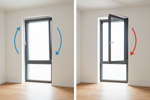
Tilt and turn windows look like standard windows from the outside but operate in a way that is completely different from any window type common in the US market. A single handle controls two distinct opening modes, and the mechanism that makes this possible is precise enough that even a minor misuse can trigger a built-in safety lock. This guide explains how everything works, from the handle to the internal hardware.
Quick Answer
Tilt and turn windows work through a single handle with three positions. Handle pointing down closes and locks the window with all locking points engaged. Handle turned 90 degrees to horizontal opens the window fully inward like a door (turn mode). Handle turned 180 degrees upward tilts the top of the sash inward for ventilation while the bottom remains locked (tilt mode).

The Three Handle Positions
Everything about how a tilt and turn window works starts with the handle. Unlike standard US windows with separate latches, cranks, or locks, the handle position alone determines whether the window is closed, ventilating, or fully open. There are exactly three positions, and each one produces a different window state.
|
Handle Position |
Window State |
What Happens Mechanically |
|
Pointing down (0 degrees) |
Closed and locked |
All locking points engage around the full frame perimeter; rubber seals compress; window is fully secured |
|
Pointing horizontal (90 degrees) |
Turn mode , fully open |
Side locking points release; concealed lower hinge engages; sash swings inward like a door on vertical hinges |
|
Pointing up (180 degrees) |
Tilt mode , ventilation gap |
Bottom and side locking points hold; top hinge points release; top of sash tilts inward 4 to 6 inches |
Handle down is always closed and locked. Handle horizontal is always turn (full open). Handle up is always tilt (top gap for ventilation). The exact angle at which tilt and turn engage varies by manufacturer, with some models reversing the horizontal and upward positions. Always check the label or markings on the handle housing when using a tilt and turn window for the first time.
Why the Handle Controls Everything
The handle is connected to an internal mechanism that runs a system of locking points all the way around the window frame. When you rotate the handle, this system either locks everything shut, releases the side so the window swings open, or releases the top so it tilts. Each position is designed to do one thing and one thing only. Forcing the handle past its natural stop point can damage the internal mechanism, so if it resists, stop and check that the sash is fully closed against the frame.
See more: Tilt and Turn Windows Pros and Cons: An Honest Assessment for US Homeowners
Tilt Mode: Controlled Ventilation
Tilt mode is what sets tilt and turn windows apart from every standard window type available in the US market. It provides ventilation without creating a security risk, exposing the room to direct draft, or allowing rain to enter the opening.

What Happens Mechanically in Tilt Mode
When you move the handle to the upward position, only the top of the window opens inward, creating a gap of about 4 to 6 inches. The bottom stays firmly against the frame the whole time. Because the gap faces inward and upward, rain hits the glass and runs away from the opening rather than into the room. This makes tilt mode a practical choice for leaving a window open during light rain or overnight without worrying about water getting in.
When to Use Tilt Mode
This mode is the correct choice for overnight ventilation in bedrooms, where a fully open window creates both a security concern and an uncomfortable direct draft. Bathrooms benefit from tilt mode's ability to extract moisture and odors continuously without fully opening the room to outdoor conditions. During rain, tilt mode allows fresh air to circulate while the angled gap prevents water entry. At ground level, tilt mode provides ventilation through an opening that is too small to climb through, which maintains security without closing off airflow entirely. The upward-directed airflow from tilt mode works better for slow, continuous background ventilation than for rapidly clearing a room, where turn mode is more appropriate.
Turn Mode: Full Inward Opening
Turn mode converts the window into what functions like an inward-opening door, providing the same ventilation capacity as a fully open casement window along with interior access to both glass surfaces for cleaning.

What Happens Mechanically in Turn Mode
When you turn the handle to the horizontal position, the entire window swings open inward like a door. This gives you a fully open, unobstructed opening for maximum airflow and easy cleaning of both sides of the glass from inside the room. The window hinges from one side and rests on a concealed lower hinge that carries the weight of the glass, which is why the quality of the hinge matters for how smoothly the window operates over years of use.
When to Use Turn Mode
This mode is appropriate when maximum airflow is needed quickly, such as clearing cooking smoke from a kitchen or opening a room after a period of heat buildup. It is also the correct mode when both glass surfaces need cleaning, since the fully inward-swinging sash makes the exterior glass surface accessible from inside the room without a ladder. It can also serve as an emergency exit point where the window size and sill height allow. It is not appropriate for use during rain or in strong wind, because the fully inward-swinging sash can be caught by wind gusts and place undue stress on the lower hinge hardware.
See more: How Wide Are French Doors Exterior? Standard Widths and How to Choose the Right Size
Browse tilt and turn window options at Doors and Beyond: Browse Tilt and Turn Windows at Doors and Beyond
Why the Handle Gets Stuck and How to Fix It
A handle that refuses to move from the tilt or turn position back to the closed position is the most common operational issue reported by first-time first-time users of this window type. In almost every case, it is not a broken mechanism. It is a built-in safety feature working exactly as it was designed to work.
The Anti-Mishandling Safety Trigger
These windows have a small metal lever or tab on the vertical edge of the sash, typically positioned near the locking points on the hinge side. This component is the anti-mishandling safety trigger. Its purpose is to prevent the handle from being rotated to the closed position when the sash is not fully pressed flat against the frame seal. If the handle were forced closed with the sash partially open, the steel locking bolts would drive into the frame at an angle rather than seating cleanly in the keepers, damaging both the bolts and the frame hardware. When the sash is not fully seated, the trigger extends outward automatically, physically blocking the handle from rotating toward the closed position. This is why the handle feels stuck even when the window appears to be in the correct position: the sash is not yet pressed fully against the frame.

Step-by-Step: How to Free a Stuck Handle
Step 1: Locate the safety trigger. Look along the vertical edge of the open sash for a small metal lever, tab, or button that is pointing outward at an angle away from the frame. It is typically positioned partway up the sash edge near the espagnolette hardware. Do not force the handle while searching for it.
Step 2: Press the trigger flat. Using a finger, press the lever or tab flat against the sash edge so it no longer projects outward. On some window models, the trigger is a small button rather than a lever; press and hold it firmly inward. Keep pressure on the trigger throughout the next step.
Step 3: Push the sash firmly closed. While holding the trigger flat, push the sash firmly against the frame until the rubber seal is fully compressed on all sides. The sash must be completely flush with the frame for the handle to rotate. A partially seated sash will keep the trigger engaged regardless of how firmly you press it.
Step 4: Rotate the handle to close. With the sash fully seated and the trigger held flat, rotate the handle to the downward (closed) position. The handle should move freely once the sash is properly pressed against the frame. Release the trigger after the handle reaches the closed position and the locking bolts have engaged.
If the handle still does not move after following all four steps, the espagnolette rods or gearbox may have shifted out of alignment and require professional adjustment. Do not force the handle past any resistance point, as this risks stripping the gearbox connection or bending the espagnolette rods. Most qualified window technicians can adjust or reset the hardware without replacing the full mechanism.
See more: Standard Sliding Glass Door Sizes: Width, Height, and Rough Opening by Panel Count
The Internal Hardware: What Makes It All Work
Understanding the four main internal components explains why this window type behaves the way they do and why handle position controls so much of the window's function. Each component has a specific role, and the failure of any one of them changes how the window operates.
The Four Core Components
A tilt and turn window has four main internal parts that work together. The handle and gearbox convert your hand movement into mechanical action inside the frame. The locking rod system runs all the way around the window and engages or releases different points depending on the handle position, which is what produces the three window states: closed, tilted, and fully open. The tilt bolt controls how far the top of the window can open and holds it at that fixed distance. The lower hinge carries the full weight of the glass when the window swings open in turn mode, so its quality directly affects how smoothly the window operates over time.
The Fail-Safe Corner Drive
There is also a built-in safety interlock inside the window that prevents tilt and turn from activating at the same time, which would damage the frame. This is why the handle always stops between positions and cannot jump directly from tilt to fully open. It is not a flaw in the design; it is a deliberate feature that protects the window and keeps it operating reliably for many years.
See more: Types of Flush Doors: Hollow Core, Solid Core, and Surface Finishes Explained
Final Thoughts
Tilt and turn windows work through a single handle that controls three precise mechanical states: closed, tilt ventilation, and full inward opening. Understanding each handle position, knowing when each mode is the right choice, and recognizing the anti-mishandling safety trigger for what it is turns a mechanically unfamiliar window type into one of the most practical and versatile options available for US homeowners today.
Ready to explore tilt-and-turn options for your home? Browse options at Doors and Beyond: Shop Tilt and Turn Windows at Doors and Beyond
How Do Tilt and Turn Windows Work? Handle Positions, Modes, and What to Do When the Handle Gets Stuck

Tilt and turn windows look like standard windows from the outside but operate in a way that is completely different from any window type common in the US market. A single handle controls two distinct opening modes, and the mechanism that makes this possible is precise enough that even a minor misuse can trigger a built-in safety lock. This guide explains how everything works, from the handle to the internal hardware.
Quick Answer
Tilt and turn windows work through a single handle with three positions. Handle pointing down closes and locks the window with all locking points engaged. Handle turned 90 degrees to horizontal opens the window fully inward like a door (turn mode). Handle turned 180 degrees upward tilts the top of the sash inward for ventilation while the bottom remains locked (tilt mode).
The Three Handle Positions
Everything about how a tilt and turn window works starts with the handle. Unlike standard US windows with separate latches, cranks, or locks, the handle position alone determines whether the window is closed, ventilating, or fully open. There are exactly three positions, and each one produces a different window state.
|
Handle Position |
Window State |
What Happens Mechanically |
|
Pointing down (0 degrees) |
Closed and locked |
All locking points engage around the full frame perimeter; rubber seals compress; window is fully secured |
|
Pointing horizontal (90 degrees) |
Turn mode , fully open |
Side locking points release; concealed lower hinge engages; sash swings inward like a door on vertical hinges |
|
Pointing up (180 degrees) |
Tilt mode , ventilation gap |
Bottom and side locking points hold; top hinge points release; top of sash tilts inward 4 to 6 inches |
Handle down is always closed and locked. Handle horizontal is always turn (full open). Handle up is always tilt (top gap for ventilation). The exact angle at which tilt and turn engage varies by manufacturer, with some models reversing the horizontal and upward positions. Always check the label or markings on the handle housing when using a tilt and turn window for the first time.
Why the Handle Controls Everything
The handle is connected to an internal mechanism that runs a system of locking points all the way around the window frame. When you rotate the handle, this system either locks everything shut, releases the side so the window swings open, or releases the top so it tilts. Each position is designed to do one thing and one thing only. Forcing the handle past its natural stop point can damage the internal mechanism, so if it resists, stop and check that the sash is fully closed against the frame.
See more: Tilt and Turn Windows Pros and Cons: An Honest Assessment for US Homeowners
Tilt Mode: Controlled Ventilation
Tilt mode is what sets tilt and turn windows apart from every standard window type available in the US market. It provides ventilation without creating a security risk, exposing the room to direct draft, or allowing rain to enter the opening.
What Happens Mechanically in Tilt Mode
When you move the handle to the upward position, only the top of the window opens inward, creating a gap of about 4 to 6 inches. The bottom stays firmly against the frame the whole time. Because the gap faces inward and upward, rain hits the glass and runs away from the opening rather than into the room. This makes tilt mode a practical choice for leaving a window open during light rain or overnight without worrying about water getting in.
When to Use Tilt Mode
This mode is the correct choice for overnight ventilation in bedrooms, where a fully open window creates both a security concern and an uncomfortable direct draft. Bathrooms benefit from tilt mode's ability to extract moisture and odors continuously without fully opening the room to outdoor conditions. During rain, tilt mode allows fresh air to circulate while the angled gap prevents water entry. At ground level, tilt mode provides ventilation through an opening that is too small to climb through, which maintains security without closing off airflow entirely. The upward-directed airflow from tilt mode works better for slow, continuous background ventilation than for rapidly clearing a room, where turn mode is more appropriate.
Turn Mode: Full Inward Opening
Turn mode converts the window into what functions like an inward-opening door, providing the same ventilation capacity as a fully open casement window along with interior access to both glass surfaces for cleaning.
What Happens Mechanically in Turn Mode
When you turn the handle to the horizontal position, the entire window swings open inward like a door. This gives you a fully open, unobstructed opening for maximum airflow and easy cleaning of both sides of the glass from inside the room. The window hinges from one side and rests on a concealed lower hinge that carries the weight of the glass, which is why the quality of the hinge matters for how smoothly the window operates over years of use.
When to Use Turn Mode
This mode is appropriate when maximum airflow is needed quickly, such as clearing cooking smoke from a kitchen or opening a room after a period of heat buildup. It is also the correct mode when both glass surfaces need cleaning, since the fully inward-swinging sash makes the exterior glass surface accessible from inside the room without a ladder. It can also serve as an emergency exit point where the window size and sill height allow. It is not appropriate for use during rain or in strong wind, because the fully inward-swinging sash can be caught by wind gusts and place undue stress on the lower hinge hardware.
See more: How Wide Are French Doors Exterior? Standard Widths and How to Choose the Right Size
Browse tilt and turn window options at Doors and Beyond: Browse Tilt and Turn Windows at Doors and Beyond
Why the Handle Gets Stuck and How to Fix It
A handle that refuses to move from the tilt or turn position back to the closed position is the most common operational issue reported by first-time first-time users of this window type. In almost every case, it is not a broken mechanism. It is a built-in safety feature working exactly as it was designed to work.
The Anti-Mishandling Safety Trigger
These windows have a small metal lever or tab on the vertical edge of the sash, typically positioned near the locking points on the hinge side. This component is the anti-mishandling safety trigger. Its purpose is to prevent the handle from being rotated to the closed position when the sash is not fully pressed flat against the frame seal. If the handle were forced closed with the sash partially open, the steel locking bolts would drive into the frame at an angle rather than seating cleanly in the keepers, damaging both the bolts and the frame hardware. When the sash is not fully seated, the trigger extends outward automatically, physically blocking the handle from rotating toward the closed position. This is why the handle feels stuck even when the window appears to be in the correct position: the sash is not yet pressed fully against the frame.
Step-by-Step: How to Free a Stuck Handle
Step 1: Locate the safety trigger. Look along the vertical edge of the open sash for a small metal lever, tab, or button that is pointing outward at an angle away from the frame. It is typically positioned partway up the sash edge near the espagnolette hardware. Do not force the handle while searching for it.
Step 2: Press the trigger flat. Using a finger, press the lever or tab flat against the sash edge so it no longer projects outward. On some window models, the trigger is a small button rather than a lever; press and hold it firmly inward. Keep pressure on the trigger throughout the next step.
Step 3: Push the sash firmly closed. While holding the trigger flat, push the sash firmly against the frame until the rubber seal is fully compressed on all sides. The sash must be completely flush with the frame for the handle to rotate. A partially seated sash will keep the trigger engaged regardless of how firmly you press it.
Step 4: Rotate the handle to close. With the sash fully seated and the trigger held flat, rotate the handle to the downward (closed) position. The handle should move freely once the sash is properly pressed against the frame. Release the trigger after the handle reaches the closed position and the locking bolts have engaged.
If the handle still does not move after following all four steps, the espagnolette rods or gearbox may have shifted out of alignment and require professional adjustment. Do not force the handle past any resistance point, as this risks stripping the gearbox connection or bending the espagnolette rods. Most qualified window technicians can adjust or reset the hardware without replacing the full mechanism.
See more: Standard Sliding Glass Door Sizes: Width, Height, and Rough Opening by Panel Count
The Internal Hardware: What Makes It All Work
Understanding the four main internal components explains why this window type behaves the way they do and why handle position controls so much of the window's function. Each component has a specific role, and the failure of any one of them changes how the window operates.
The Four Core Components
A tilt and turn window has four main internal parts that work together. The handle and gearbox convert your hand movement into mechanical action inside the frame. The locking rod system runs all the way around the window and engages or releases different points depending on the handle position, which is what produces the three window states: closed, tilted, and fully open. The tilt bolt controls how far the top of the window can open and holds it at that fixed distance. The lower hinge carries the full weight of the glass when the window swings open in turn mode, so its quality directly affects how smoothly the window operates over time.
The Fail-Safe Corner Drive
There is also a built-in safety interlock inside the window that prevents tilt and turn from activating at the same time, which would damage the frame. This is why the handle always stops between positions and cannot jump directly from tilt to fully open. It is not a flaw in the design; it is a deliberate feature that protects the window and keeps it operating reliably for many years.
See more: Types of Flush Doors: Hollow Core, Solid Core, and Surface Finishes Explained
Final Thoughts
Tilt and turn windows work through a single handle that controls three precise mechanical states: closed, tilt ventilation, and full inward opening. Understanding each handle position, knowing when each mode is the right choice, and recognizing the anti-mishandling safety trigger for what it is turns a mechanically unfamiliar window type into one of the most practical and versatile options available for US homeowners today.
Ready to explore tilt-and-turn options for your home? Browse options at Doors and Beyond: Shop Tilt and Turn Windows at Doors and Beyond
Recent Post

How to Clean Tilt and Turn Windows: Glass, Frame, Hardware, and What Products to Avoid
Read More
Single Tilt and Turn Windows as Egress Windows: What You Need to Know
Read More
